Last verified: October 1, 2026
A standby generator mostly sits and waits, which is why maintenance gets forgotten until the day it fails to start. Generac’s air-cooled generators need an oil and filter change every 2 years or 200 hours, a bigger service every 4 years or 400 hours, a yearly battery check and quick owner checks, plus a pre-storm routine. In cold climates or long hot-weather runs, the oil interval shortens to every year or 100 hours. The intervals below are from Generac’s owner’s manual for its 9–22 kW air-cooled models; other brands are similar, but always follow your own manual.
The manufacturer’s schedule
| Task | When |
|---|---|
| Change oil and oil filter, check valve clearance (break-in) | After the first 25 hours of operation |
| Check oil level, fuel and oil leaks, enclosure louvers, water intrusion | Daily if running continuously, or before each use |
| Check battery condition and state of charge | Every year |
| Replace engine oil and oil filter (Schedule A) | Every 2 years or 200 hours |
| Replace oil and filter, air filter and spark plugs; inspect valve clearance (Schedule B) | Every 4 years or 400 hours |
| Oil and filter in cold (below 40°F) or continuous hot (above 85°F) conditions | Every year or 100 hours |
Source: Generac Owner’s Manual, 60 Hz air-cooled generators 9–22 kW, service schedule. The manual also says to check the oil level daily when an outage keeps the generator running for long periods. A week of continuous use is 168 hours, close to the 200-hour oil interval.
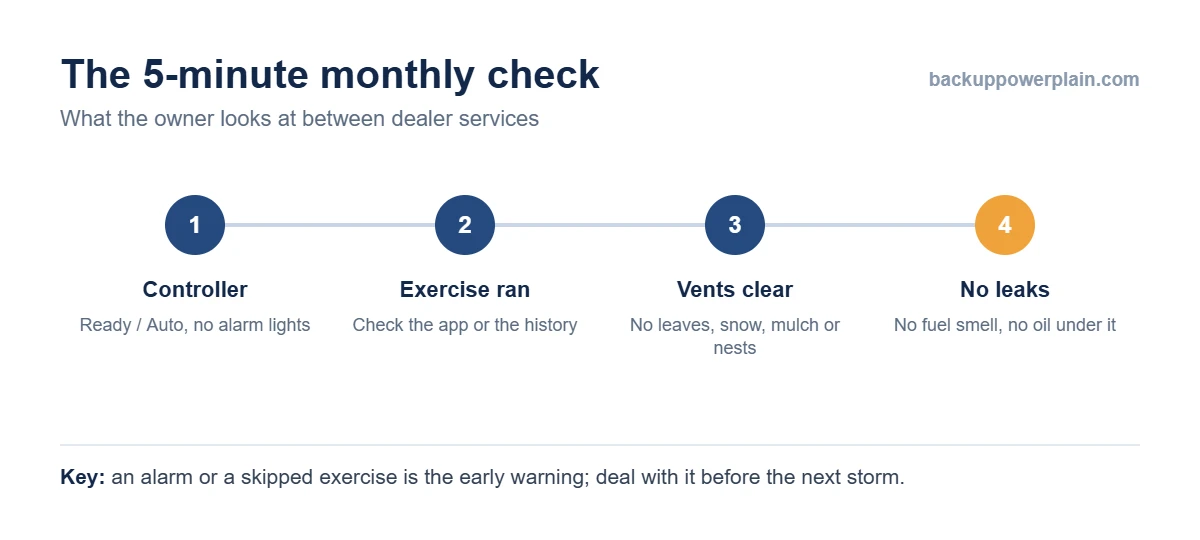
Monthly owner checklist (5 minutes)
- Controller shows Ready / Auto and no alarm lights.
- Weekly exercise ran on schedule (check the app or the controller’s history).
- Nothing blocks the air vents: leaves, snow, mulch, shrubs, wasps’ nests.
- No fuel smell, no oil on the ground, no rodent damage.
- Gas shut-off valve to the generator is open.
Dealer service
Most owners have a dealer do the scheduled services, often on a maintenance plan. Many owners book a visit every year anyway, especially in cold or coastal climates. Ask for the yearly price in writing. The visit should include:
At minimum, it should cover an oil and oil filter change when due (every 2 years or 200 hours; yearly in cold or hot-weather duty) with the oil grade the manual specifies, plus a battery test, terminal cleaning and replacement if the battery fails. The technician should also inspect the fuel lines, wiring, transfer switch and enclosure, update the controller software and review the error log, and run a test under load if possible.
Every 4 years or 400 hours, the service adds a new air filter, new spark plugs and a valve clearance check.
Pre-storm checklist
When a hurricane or winter storm is forecast:
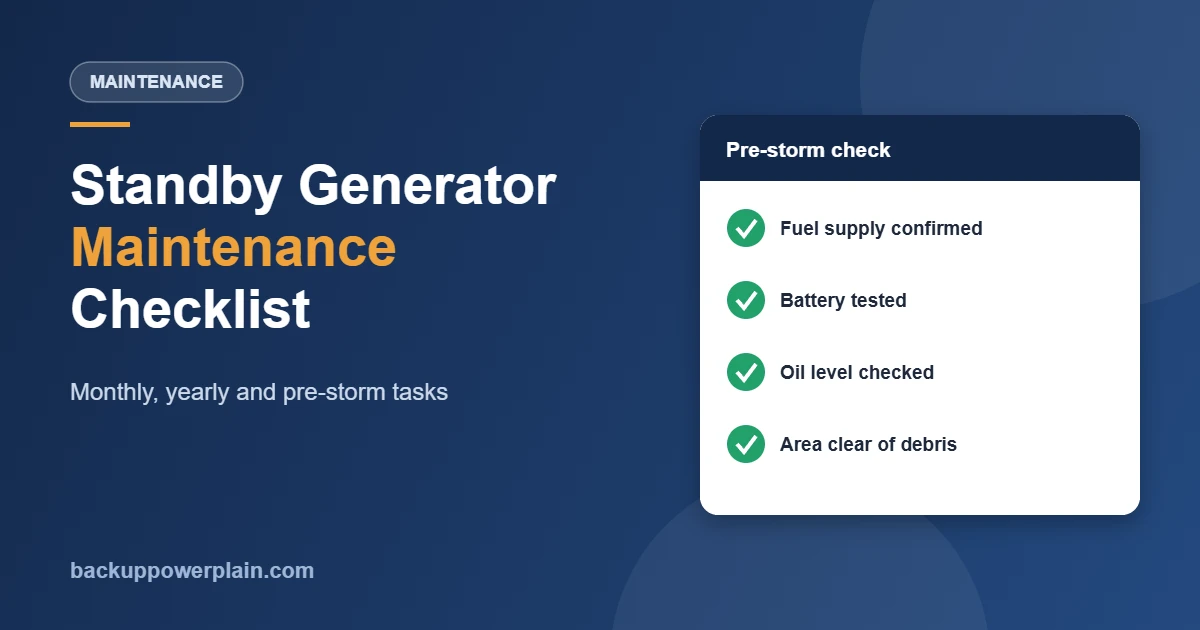
- Check the oil level and top up if needed. Keep a quart or two of the right oil and a spare oil filter at home for long outages.
- Propane users: confirm the tank level and order a refill early.
- Clear vents and the area around the unit; secure loose items that could blow into it.
- Confirm the controller is in Auto.
- Make sure CO alarms in the house have working batteries.
During a long outage
Track run hours. Many owners’ manuals call for checking oil during extended operation; follow yours, and only open the unit with the engine stopped and cooled. Keep snow and debris away from the vents, and reduce big loads where possible to save fuel.
A year of maintenance, month by month
In January and February, clear snow and ice from the vents after storms and check that the exercise ran. If you’re on the yearly cold-climate schedule, this is when the dealer does the oil change. In March and April, trim plants back to 3 feet, look for rodent nests in and around the enclosure, and book the spring service and battery check.
May is for getting ready: run through a pre-storm checklist, fill the propane tank and stock oil and a filter. Any service that’s due should be done before hurricane season starts. From June to November, watch the exercise once a month and keep leaves away from the unit. After a long outage, ask about an oil change if the hours are close to the interval. In December, check the exercise schedule against Daylight Saving Time, note the run hours and plan next year’s service.
Keeping a maintenance log
A simple log protects your warranty and helps you spot trends. Record the date, run hours from the controller, what was done (oil, filter, battery, plugs), the oil type and quantity, and who did it. Note any alarms and how they were resolved. Keep receipts for parts and dealer invoices in the same place. Generac’s owner’s manual includes a maintenance log page for this purpose.
Signs your generator needs attention between services
Call your dealer if the controller shows an alarm or a maintenance message (Service A or B), or if the weekly exercise didn’t run or took several attempts to start. Oil spots under the unit, a smell of gas, or unusual noise, vibration or smoke during the exercise also need a look. Near the coast, watch for corrosion on the enclosure or connections. Generac’s manual recommends periodic visual corrosion checks and washing the enclosure by hand, not with a hose or power washer.
For alarm meanings, see Generac Generator Alarms Explained.
How much does yearly maintenance cost?
It depends on your dealer and what’s included. Ask for a written price for each scheduled service (Schedule A and Schedule B on Generac units) and compare it with a maintenance plan. See Is a Generator Maintenance Plan Worth It?
Can I skip maintenance if the generator rarely runs?
No. Oil ages and batteries weaken even without running, which is why the schedule has time limits (2 and 4 years) as well as hour limits.
What’s the most common maintenance failure?
A weak or dead starter battery. That’s why Generac calls for a yearly battery check and why the controller shows battery warnings.
Things not to do
Don’t spray the unit with a pressure washer or block it with covers not designed for it. Don’t turn off the weekly exercise to save fuel, because it is how problems show up before an outage. And don’t open the controller or electrical compartments: leave electrical work to the dealer or an electrician.
Generator didn’t start? See Generac generator won’t start and what common alarm messages mean.
Related guides
- How to Prepare Your Generator Before Hurricane Season
- Is a Generator Maintenance Plan Worth It?
- Generator Oil Change: How Often and Which Oil to Use
- Generator Exercise Settings: How Often Should a Standby Generator Run?
Sources

About BackupPowerPlain
BackupPowerPlain is a team specialized in home backup power. We turn generator manuals, spec sheets and official safety guidance into plain guides with the math shown. We don't sell or install generators and have no brand to push.