Last verified: October 13, 2026
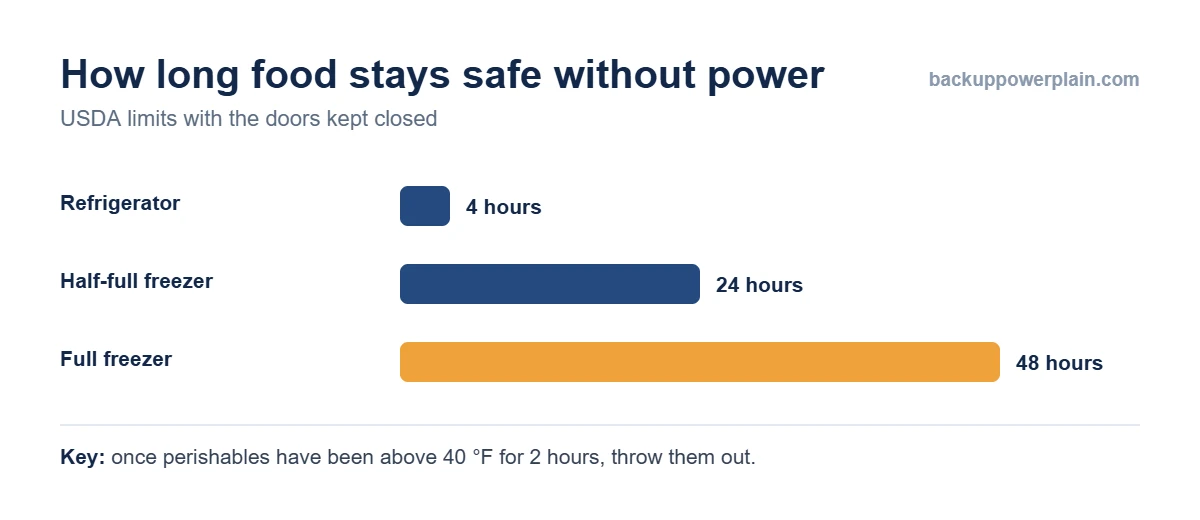
When the power goes out, the clock starts on everything in your fridge and freezer. The USDA’s numbers are simple: about 4 hours for a closed refrigerator, about 48 hours for a full freezer and about 24 hours for a half-full one. After that, some food has to go. This guide explains those limits, gives you a tool to check your own situation, and shows where a generator actually changes the outcome.
The four numbers to remember
The USDA Food Safety and Inspection Service gives these limits for an outage, assuming you keep the doors shut:
| What | Limit | Why it matters |
|---|---|---|
| Refrigerator | About 4 hours | A closed fridge keeps food safely cold for about 4 hours. |
| Full freezer | About 48 hours | A packed freezer holds its temperature for roughly two days. |
| Half-full freezer | About 24 hours | Less frozen mass means it warms faster. |
| Perishable food above 40 °F | 2 hours | Meat, poultry, fish, eggs and leftovers should be thrown out once they have been above 40 °F for 2 hours. |
The targets in normal use are 40 °F or below in the fridge and 0 °F or below in the freezer. The only way to know where you stand is a thermometer, which is why the USDA recommends keeping appliance thermometers in both at all times.
Check your fridge and freezer
Enter how long the power has been out and how full your freezer is. The second part tells you what to keep and what to throw out from the fridge once food has been above 40 °F for more than 2 hours.
Outage food clock
Based on USDA guidance for closed appliances. A thermometer reading always beats the clock.
Fridge food check
For food that has been above 40 °F for more than 2 hours.
Source: USDA FSIS and FoodSafety.gov. When in doubt, throw it out.
What to keep and what to throw out
FoodSafety.gov publishes a full chart for refrigerated food held above 40 °F for more than 2 hours. The pattern is easy to learn: anything moist and high in protein goes, while hard, dry, acidic or sugary foods usually survive.
- Throw out: raw and cooked meat, poultry and seafood, lunch meat and hot dogs, milk, cream, yogurt, soft and shredded cheese, eggs and egg dishes, cooked leftovers, cut fruit and vegetables, opened mayonnaise and creamy dressings.
- Usually safe: hard cheeses such as Cheddar and Parmesan, butter and margarine, uncut fresh fruit and vegetables, bread and rolls, jelly, mustard, ketchup, pickles and vinegar-based dressings.
Never taste food to decide. When you are not sure, throw it out.
Frozen food: when you can refreeze
Food in the freezer can be refrozen if it still has ice crystals or is at 40 °F or below. Check each item on its own, and throw out anything that sat in juice from raw meat. A full freezer is your friend here: frozen items keep each other cold, which is the whole reason a full freezer lasts twice as long as a half-empty one.
If the outage will run past the freezer's limit and you have no backup power, dry ice buys time. The USDA's rule of thumb is that 50 pounds of dry ice will hold an 18 cubic foot full freezer for 2 days.
Where a generator changes the math
A generator does not need to power the whole house to save your food. It only needs to keep two appliances running.
- Short outages (under 4 hours): no generator needed for food. Keep the doors closed.
- Overnight to one day: the fridge is past its limit, a half-full freezer is close to it. A portable generator that can run the fridge and freezer covers this.
- Two days or more: even a full freezer is at risk. This is where a standby generator, or a portable with enough fuel stored, pays for itself.
A practical example: a storm knocks out power at 6 p.m. and it comes back at midnight the next day, 30 hours later. The fridge passed its 4 hour mark that first night, so meat, milk and leftovers that warmed above 40 °F for 2 hours have to go. A half-full freezer passed 24 hours around dinner time on day two, so each item needs a check for ice crystals. With a generator running the fridge and freezer from the first evening, none of that happens.
If you go the generator route, make sure the unit can handle the start-up surge of a refrigerator compressor, and always run it outdoors, away from windows and doors.
A short checklist for the next outage
- Put an appliance thermometer in the fridge and the freezer now, before you need it.
- Keep the freezer full. Bottles of frozen water fill gaps and double as ice packs.
- Note the time the power goes out.
- Keep the doors closed. Every opening shortens the clock.
- When power returns, check temperatures before deciding what to keep.
Related guides
- Generator Size for a Well Pump, Sump Pump and Fridge
- How Long Can a Generator Run Continuously?
- How to Prepare Your Generator Before Hurricane Season
- Generator Carbon Monoxide Safety: The Distances That Actually Matter
Sources
This article summarizes federal food safety guidance. When in doubt about a specific food, follow the FoodSafety.gov chart or throw it out.
About BackupPowerPlain
BackupPowerPlain is a team specialized in home backup power. We turn generator manuals, spec sheets and official safety guidance into plain guides with the math shown. We don't sell or install generators and have no brand to push.