Last verified: October 18, 2026
If you use a CPAP, a night without power is not just uncomfortable. The good news is that a CPAP is one of the easiest things in the house to keep running: it needs a few dozen watts, not thousands. This guide shows how much power a typical machine really draws, what that means in watt-hours for a full night, and how to choose between a battery, a portable power station and a generator. There is also a calculator to check how many nights your backup will last.
This page is about power, not therapy. Follow your doctor’s instructions and your machine’s user manual, and ask your equipment supplier before connecting your device to any battery, inverter or generator.
The short answer
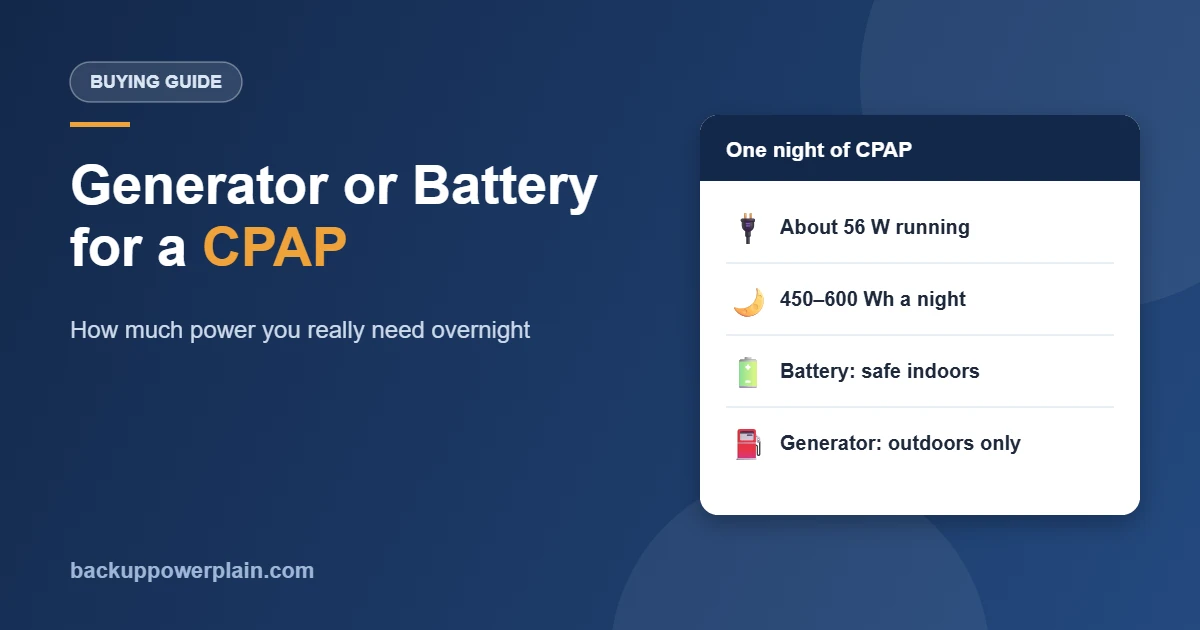
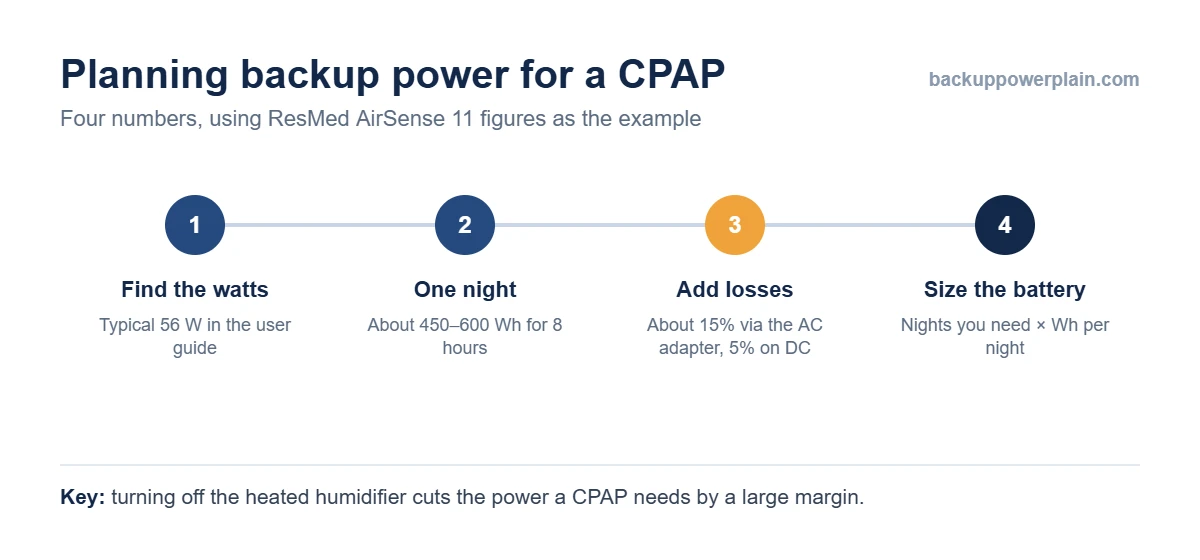
- A CPAP uses tens of watts, not hundreds. ResMed’s AirSense 11 user guide lists a typical consumption of 56.1 W and a peak of 73.2 W.
- A full 8-hour night is roughly 450 to 600 watt-hours at those figures. Turning off the heated humidifier and heated tube is the single biggest way to cut that.
- For one or two nights, a battery or portable power station is usually the simplest option. It is silent, sits by the bed and produces no exhaust.
- For multi-day outages, a generator can recharge that battery during the day. It must always run outdoors, at least 20 feet from the house.
How much power a CPAP actually uses
Every machine lists its power figures in the technical specifications section of its user guide. Here is what ResMed publishes for the AirSense 11 with its standard 65 W power supply, and what those numbers mean for a night of sleep:
| ResMed AirSense 11 figure | Value | Energy for an 8-hour night |
|---|---|---|
| Typical power consumption | 56.1 W (111.5 VA) | 56.1 × 8 = about 449 Wh |
| Peak power consumption | 73.2 W (137.6 VA) | 73.2 × 8 = about 586 Wh (worst case) |
| Power supply | 65 W, 100–240 V AC in, 24 V DC out | The brick that sits between the wall and the machine |
Real nights usually land below the peak figure. The draw depends on your pressure, mask leak, room temperature and, above all, whether the heated humidifier and heated tube are on. Battery makers publish much shorter run times with humidification on than off, so if you need to stretch a battery, those are the settings to change first, after checking with your care provider.
Watts vs VA: the number that trips people up
Notice that ResMed lists two numbers: 56.1 W and 111.5 VA. Watts tell you how much energy you will use. Volt-amps (VA) tell you how much current the power supply pulls, which is what a small UPS or inverter has to handle. That is why a UPS rated “150 VA” may struggle even though the machine only uses about 56 W. Size any inverter or UPS for the VA and peak figures, with room to spare. Philips, for example, recommends a DC-to-AC inverter of 150 W or more when running its DreamStation Go from an external battery.
Check how many nights your backup will last
Enter your machine’s power draw (from the manual or a plug-in watt meter), how long you sleep and your battery’s capacity in watt-hours. The calculator subtracts conversion losses if you plug the CPAP’s normal AC power supply into the battery’s outlet.
CPAP backup runtime calculator
An estimate, not a guarantee. Battery age, cold rooms and mask leak all shorten real run time.
56 W is ResMed’s typical figure for the AirSense 11. Use 73 W for a worst case.
Printed on the battery or power station, in watt-hours.
Conversion losses are typical round figures, not measured values for your equipment.
Your backup options, side by side
| Option | Best for | Advantages | Watch out for |
|---|---|---|---|
| Battery made for your CPAP model | One or two nights, travel | Designed and listed for your machine, often with a DC connection that wastes less energy | Smaller capacity; run time drops sharply with the humidifier on |
| Portable power station (lithium battery with AC outlets) | One to several nights | Silent, no exhaust, can run other small loads such as a phone or a light | Check its inverter rating and that your manufacturer allows it; recharge needs grid power, solar or a generator |
| Portable generator | Multi-day outages, recharging batteries | Unlimited run time while fuel lasts; can also run a fridge or sump pump | Must run outdoors, at least 20 feet from the house; noise; fuel storage |
| Home standby generator | Frequent or long outages, whole-house needs | Starts automatically; you may sleep through the outage | Thousands of dollars installed; overkill for a CPAP alone |
For many households the best setup is a combination: a battery or power station next to the bed for the night, and a generator outside during the day to recharge it and keep the fridge cold. That way nobody sleeps near a running engine. Our generator vs battery backup comparison goes deeper on costs and run times for the whole house.
If you run your CPAP from a generator
- Ask first. The FDA's advice for home medical devices is to read your user instructions or call your distributor or manufacturer to find out whether your device can be used with batteries or a generator.
- Prefer clean power for electronics. If your manual has power-quality requirements, follow them. Many owners use an inverter generator, or put a battery between the generator and the CPAP so the machine never runs directly on the engine. Our guide to inverter vs conventional generators explains the difference.
- Keep it outside, at least 20 feet away. The Consumer Product Safety Commission says to operate portable generators outside only, at least 20 feet from the house, and not on a porch or in a carport. Opening doors or windows does not provide enough ventilation.
- Point the exhaust away from the house and fit CO alarms. CPSC recommends battery-operated or battery-backup CO alarms on every level and outside sleeping areas, and generators with a carbon monoxide shut-off feature. See our generator carbon monoxide safety guide.
- Use a proper connection. A heavy-duty outdoor extension cord to the bedside, or a transfer switch or interlock installed by an electrician. Never plug a generator into a wall outlet. Backfeeding is dangerous and illegal.
Before the next outage: a short checklist
- Tell your utility and fire department that you rely on a powered medical device. The FDA recommends this, and many utilities keep a list of customers who need priority notice.
- Write down your machine's power figures from the specifications page of the user guide, or measure them for one night with a plug-in watt meter.
- Test your backup for a full night while the grid is still on, so you know the real run time with your settings.
- Keep the battery charged and recharge it after any test. Batteries lose capacity with age and in the cold.
- Check for water before plugging in, and do not use a cord or device that is wet, as the FDA warns.
- Check your settings when power returns. According to the FDA, medical devices often reset to a default mode when power is interrupted.
Frequently asked questions
What size generator do I need for just a CPAP?
Almost any generator has enough output for a single CPAP, because the machine needs well under 100 W. The real questions are power quality, noise and safety, which is why a battery by the bed charged by a generator outside is often a better plan than running the CPAP straight from the engine. If you also want the fridge, a sump pump or a well pump, size for those with our generator size calculator.
Can I use my car to power a CPAP?
Some machines have manufacturer DC cables or converters for 12 V sources. Never sleep in or near a running car in a closed garage: an idling engine produces carbon monoxide just like a generator.
Is a UPS (computer battery backup) enough?
A typical small UPS is designed to keep a computer on for a few minutes, not a CPAP for a night. Check its watt-hour capacity, not just its VA rating, and run the numbers in the calculator above.
Keep reading
- Oxygen concentrator in a power outage: your backup plan
- How long food stays safe in a power outage
- How to choose a portable generator for home backup
- Standby vs portable generator
Sources
- ResMed, AirSense 11 user guide, technical specifications (65 W power supply unit; typical power consumption 56.1 W / 111.5 VA; peak 73.2 W / 137.6 VA)
- Philips, charging the DreamStation Go from a DC power source
- U.S. FDA, tips about medical devices and natural disasters
- U.S. Consumer Product Safety Commission, winter storm generator and CO safety tips (2026)
- U.S. Consumer Product Safety Commission, generator, CO and fire hazards ahead of hurricane season (2026)
- CPSC, Carbon Monoxide Information Center
About BackupPowerPlain
BackupPowerPlain is a team specialized in home backup power. We turn generator manuals, spec sheets and official safety guidance into plain guides with the math shown. We don't sell or install generators and have no brand to push.