Last verified: November 8, 2026 · Reviewed by Javier Braojos, electrical engineer
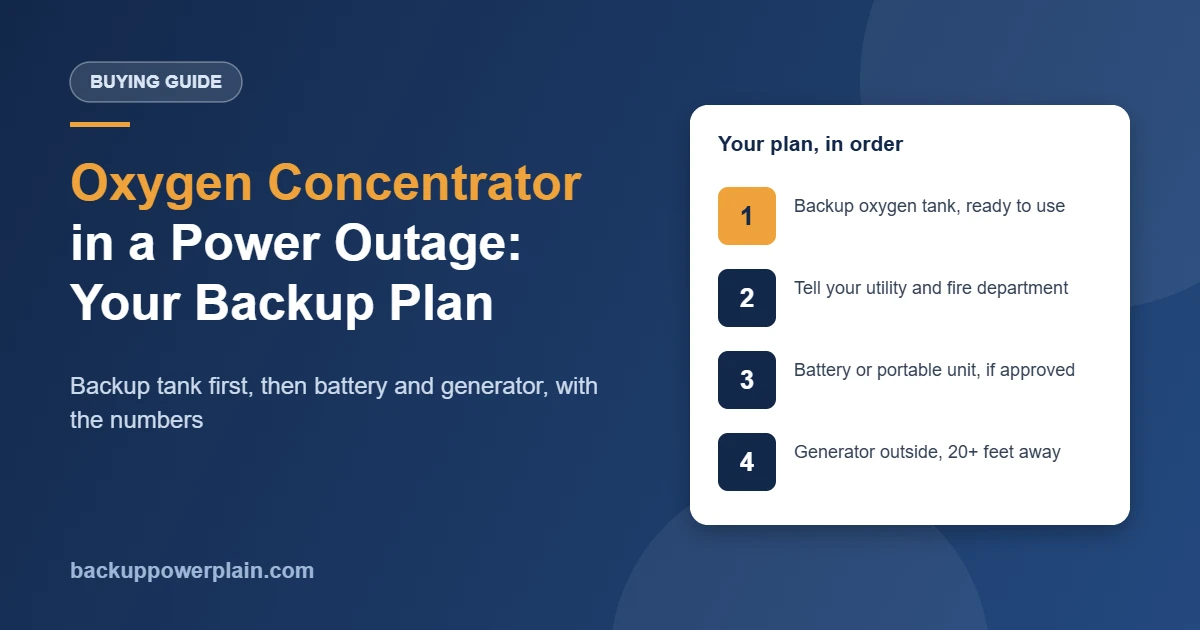
A home oxygen concentrator stops when the power stops. If you or someone in your home relies on one, an outage is not something to figure out in the dark. This guide puts the options in the right order: the backup tank that everything else depends on, the calls to make before a storm, and how much battery or generator power a concentrator actually needs.
This page is about power, not treatment. Follow your prescriber’s orders and your oxygen supplier’s instructions, and never change your flow rate on your own. If you depend on your device to stay alive and cannot power it, seek emergency services immediately, as the FDA advises.
The short answer
- Your first backup is oxygen, not electricity. MedlinePlus says you must have a backup tank of oxygen gas in case the power goes out.
- A home concentrator uses a few hundred watts. Philips lists an average of 350 watts for its EverFlo, so it is a modest load, but one that runs all day and night.
- A battery buys hours, not days. A 2,000 Wh power station runs that concentrator for roughly 5 hours.
- A generator can keep it going longer, but ask your supplier or the manufacturer first whether your device can be used with one. It must run outside, at least 20 feet from the house.
Step 1: Backup oxygen and two phone calls
Before you think about equipment, do the things that cost little and matter most.
- Keep a backup tank. The American Lung Association says to keep backup equipment, normally a large oxygen tank. Ask your supplier how long it will last at your prescribed flow, write that number down and watch the gauge. Give the supplier plenty of time to deliver refills.
- Tell your electric company. The Lung Association says to tell your power company that you have life-sustaining equipment at home.
- Tell the fire department. MedlinePlus advises telling your local fire department, electric company and telephone company that you use oxygen, and says they will try to restore power to you sooner. No one can promise that, so plan as if the outage will be long.
- Ask about evacuation early. If severe weather is forecast and you depend on your device, the FDA suggests notifying your local public health authority to request evacuation before it arrives, if possible.
Step 2: How much power a concentrator needs
As an example, Philips lists these figures for its EverFlo home concentrator: 120 VAC input, 0.5 to 5 liters per minute and 350 watts of average power consumption. Other models differ, so look in your user manual or ask your supplier. An average figure also does not tell you how much the compressor draws when it starts, so ask for that number before you pick a battery or an inverter.
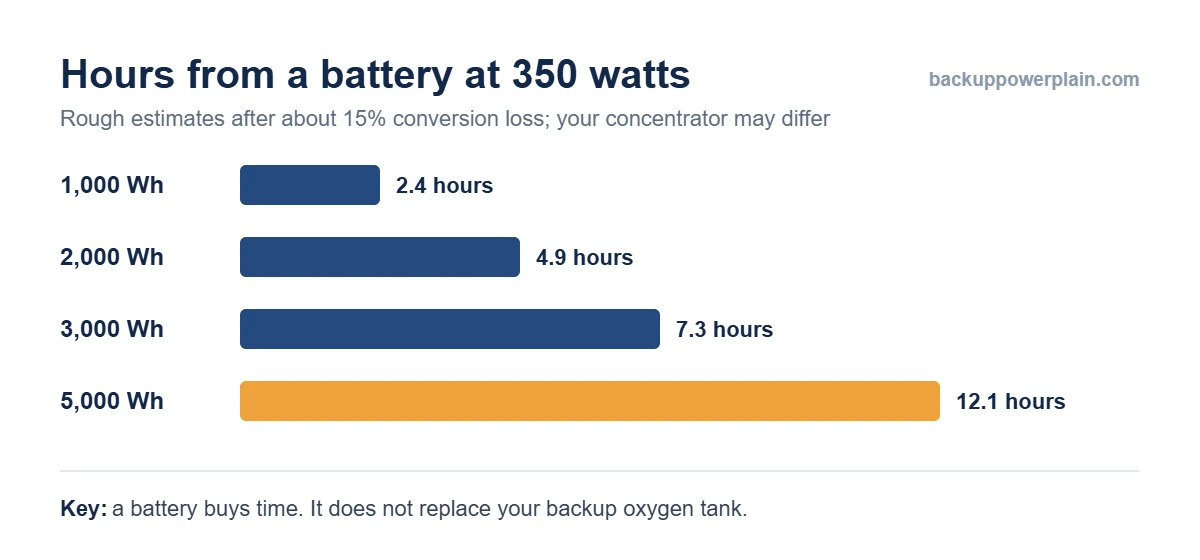
Over a full day, 350 watts adds up: 350 W × 24 hours = 8,400 watt-hours. That is why a portable power station alone is rarely a plan for a multi-day outage, and why it works better as a bridge while you change over to a tank or start a generator.
Step 3: Choose your electric backup
| Option | Good for | Watch out for |
|---|---|---|
| Portable battery-operated concentrator | Short outages and leaving the house | It may not match your prescribed flow; ask your prescriber or supplier |
| Battery power station | Silent indoor power for a few hours | Must handle the starting draw; test it with the concentrator before you need it |
| Portable generator | Recharging batteries and longer outages | Outdoors only, needs fuel and someone able to run it |
| Standby generator | Automatic power, no refueling on natural gas | Cost and installation; there is still a gap of seconds, so keep the tank ready |
If a generator is the right answer for your home, read how to choose a portable generator for home backup and standby vs portable generators. The concentrator alone is a small load, so a fridge, a sump pump or a furnace fan will likely decide the size. Our generator size calculator adds it all up.
Fire and carbon monoxide: the rules that don’t bend
Outages are when people reach for candles, gas lamps and camp stoves, which is exactly what you can’t do around oxygen. As the Lung Association explains, oxygen isn’t itself flammable, but materials burn more readily in an oxygen-enriched environment.
- Use battery lights only. The FDA says to use battery-powered flashlights or lanterns rather than gas lights or torches when oxygen is in use.
- Keep heat and flame at least five feet away, from where the unit is used or stored, and don’t use oxygen while cooking with gas, the Lung Association says. No smoking, by anyone, near you.
- Run a generator outside only, at least 20 feet from the house with the exhaust pointed away, as the CPSC says. The FDA adds: never in a basement, garage or other enclosed structure, even if doors or windows are open. Keep it away from your oxygen and stored fuel away from both. See generator carbon monoxide safety.
- Check for water first. The FDA says not to plug in a power cord if the cord or device is wet.
- Check the settings when power returns. The FDA notes that medical devices often reset to a default mode when power is interrupted.
Test your plan before the storm
- Practice switching to the backup tank with your supplier’s instructions, including at night.
- Run the concentrator on your battery or generator once, with your supplier’s approval, and time how long the battery really lasts.
- Show a family member or neighbor where everything is. MedlinePlus advises telling family, neighbors and friends that you use oxygen.
- Keep phone numbers for your supplier, power company and prescriber on paper, in case your phone dies.
Frequently asked questions
What size generator do I need for an oxygen concentrator?
A concentrator averaging 350 watts is well within the range of most portable generators, but the right answer depends on its starting draw and whatever else you plan to run. Ask the manufacturer whether your model can be used on generator power at all, then size for your whole list.
Can I use a small UPS (computer battery backup)?
Check its watt and watt-hour ratings. Many small units are designed to keep a computer on for minutes, so even if it starts the concentrator, it won’t last long. Treat it only as a bridge to your tank, and only if your supplier agrees.
Keep reading
- How to keep a CPAP running in a power outage
- How to get your generator ready for winter and ice storms
- Generator vs battery backup
Sources
- U.S. FDA, tips about medical devices and natural disasters
- American Lung Association, Using oxygen safely
- MedlinePlus, Using oxygen at home
- Philips Respironics, EverFlo product specifications
- U.S. Consumer Product Safety Commission, winter storm carbon monoxide and fire warning (February 19, 2026)
About BackupPowerPlain
BackupPowerPlain is a team specialized in home backup power. We turn generator manuals, spec sheets and official safety guidance into plain guides with the math shown. We don't sell or install generators and have no brand to push.