Last verified: November 15, 2026
Storms and outages arrive together, so sooner or later you will want to run a portable generator while it is raining or snowing. The manufacturers are clear that a portable generator should not get wet, and the U.S. Consumer Product Safety Commission (CPSC) says consumer-grade generators are not weatherproof. This guide explains what that means in practice: when to wait, what kind of cover is acceptable, and the mistakes that turn a wet generator into a shock or carbon monoxide hazard.
The short answer
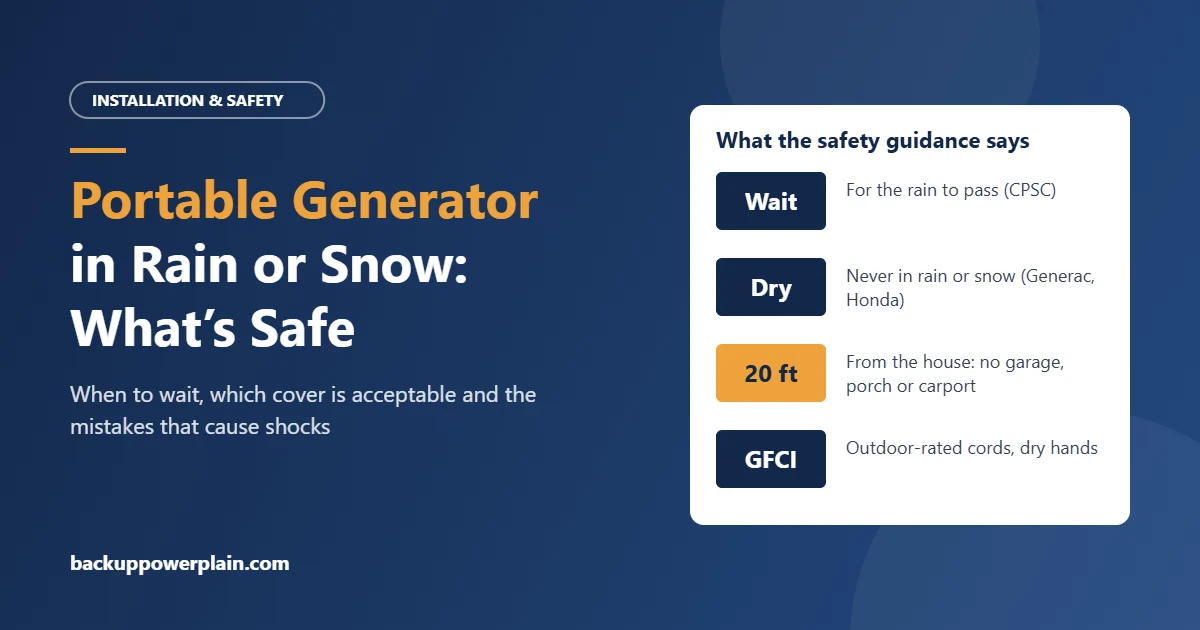
- Don’t run a portable generator in the rain or snow. Generac and Honda both say so in their safety instructions, and the CPSC advises waiting for the rain to pass.
- If you must run it, use only the protection your owner’s manual allows. The CPSC notes that some instructions call for an NFPA-rated, non-combustible generator tent.
- Never move it somewhere “dry” but enclosed. A garage, a porch and a carport are all too close to the house.
- Keep yourself and the connections dry. Dry hands, dry footing, outdoor-rated cords and GFCI protection.
Why water and a portable generator don’t mix
A portable generator has open outlets on its control panel and produces household voltage. Water on the panel, in the outlets or on the cord connections gives the current a path through whatever it touches, including you. Honda’s owner’s manual for the EB3000c puts it plainly: the generator is a potential source of electrical shock, it should not be exposed to moisture, rain or snow, and it should not be operated with wet hands. The same manual warns that using it in wet conditions such as rain or snow could result in electrocution.
Generac’s help center gives the same instruction in its storm safety list: do not operate the generator in wet conditions, such as rain or snow, and run it only on a level surface where it won’t be exposed to excessive moisture. The CPSC’s hurricane safety alert adds the reason in one line: consumer-grade generators are not weatherproof and can pose the risk of electrocution and shock when used in wet conditions.
The second danger is indirect. When it rains, people pull the generator closer to the house to keep it dry, and that is how carbon monoxide gets inside. The rules about distance do not change because of the weather.
Before you start it in bad weather: four checks

- Can you wait? The CPSC advises waiting for the rain to pass before using a generator. According to FoodSafety.gov, a full freezer holds its temperature for about 48 hours and a closed refrigerator for about 4 hours, so a short wait rarely costs you food. Our food safety guide has the limits.
- What does your manual allow? If you can’t wait, read the weather section of your owner’s manual. The CPSC says instructions may call for an NFPA-rated, non-combustible generator tent, or may say to wait until the rain passes. Use only the type of cover the manual names, and only if it keeps the clearance the manual requires. Generac, for example, calls for 5 feet of clearance on all sides for ventilation.
- Is it still in the right place? Outdoors, at least 20 feet from the house, with the exhaust pointed away from windows, doors and vents. Not in a garage, not on a porch and not in a carport. Our carbon monoxide safety guide explains the distances.
- Are you and the cords dry? Start and connect the generator with dry hands, standing on dry ground. Use heavy-duty, outdoor-rated extension cords and keep the plug connections off wet ground. OSHA recommends ground-fault circuit interrupters (GFCIs) and advises against standing in wet areas when using portable electrical equipment.
Common mistakes and what they cause
| Mistake | Why it’s dangerous | Do this instead |
|---|---|---|
| Running it in the garage, even with the door open | Carbon monoxide builds up and can enter the house. Generac says never to run a generator indoors or in partly enclosed areas such as garages. | Run it outdoors, at least 20 feet from the house |
| Running it on the porch or under a carport to keep it dry | The CPSC says both are too close to the home | Wait for the rain to pass, or use the cover your manual allows in the right spot |
| Throwing a tarp over a running generator | A tarp is not the NFPA-rated, non-combustible tent the CPSC mentions, and it blocks the clearance the generator needs for ventilation | Use only the cover your owner’s manual names |
| Leaving cord connections in puddles or snow | Water at a connection creates a shock path | Outdoor-rated cords, connections kept off the ground and GFCI protection |
| Touching the panel with wet hands or standing in water | Honda’s manual warns this could result in electrocution | Dry your hands and stand on dry ground before you start or plug in |
| Refueling while it runs, to save a trip in the rain | Fuel on a hot engine is a fire risk. OSHA says to turn generators off and let them cool before refueling. | Shut it off, let it cool, then refuel |
| Leaving it uncovered outside between uses | Generac says generators should be protected from the elements when not in use to prevent shorting and rusting | Store it dry, and check the control panel before using it again |
Snow is a slightly different problem
Falling snow is still water, so the same rule applies: the manufacturers say not to run the generator in snow. Snow that has already fallen brings two extra problems. It can pile up around the generator and take away the clearance it needs, and it hides puddles and slush where your cords lie. Generac asks owners to keep the area around a generator clean and free from debris, so clear a flat, dry spot before you set it down, and keep the cords out of the slush.
If you have a home standby generator, the situation is different: its enclosure is built to sit outside all year. What it needs in winter is covered in our winter generator guide.
Questions people ask
Can I run my generator under a pop-up canopy?
Only if your owner’s manual allows that kind of cover, and only if the generator still has its full clearance and stays at least 20 feet from the house. The CPSC refers to NFPA-rated, non-combustible generator tents; an ordinary camping canopy is not one. When in doubt, wait for the rain to stop.
My generator got rained on. Can I still use it?
Don’t start it while the control panel or outlets are wet. Honda’s manual says that if a generator is stored outdoors without weather protection, you should check all the electrical components on the control panel before each use, and Generac recommends contacting an authorized service provider for repairs. If anything looks damp, corroded or damaged, have it checked before you plug in.
Does the extension cord matter in wet weather?
Yes. The CPSC recommends heavy-duty, outdoor-rated extension cords for portable generators, and the cord also has to be thick enough for the load. Our extension cord gauge guide shows how to pick one.
Before the next storm
Read the weather section of your manual now, while the sky is clear, and decide where the generator will go: a flat spot at least 20 feet from the house that you can reach without dragging cords through puddles. If your manual allows a specific cover, buy it before you need it. And if you find you run a generator in bad weather often, a standby generator or a battery system may be the better answer; our standby vs portable comparison walks through the trade-offs.
Sources
- Generac Help Center, Can a portable generator be used in the rain or during a storm? (April 2025)
- Honda, EB3000c generator owner’s manual, safety information
- U.S. Consumer Product Safety Commission, Surviving the Aftermath of a Hurricane (safety alert)
- U.S. Consumer Product Safety Commission, CPSC urges flood victims to take steps to prevent CO poisoning, electrocution, explosion and fires (July 11, 2023)
- OSHA, Working Safely with Electricity (fact sheet)
- FoodSafety.gov, Food safety during a power outage
About BackupPowerPlain
BackupPowerPlain is a team specialized in home backup power. We turn generator manuals, spec sheets and official safety guidance into plain guides with the math shown. We don't sell or install generators and have no brand to push.