Last verified: October 23, 2026 · Reviewed by Javier Braojos, electrical engineer
The cord between your portable generator and your appliances is the part most people buy last and think about least. It is also where a lot of outage problems start: a thin indoor cord that gets hot under a space heater, a 100-foot run that leaves a fridge compressor struggling, or a plug that does not fit the generator’s outlet at all.
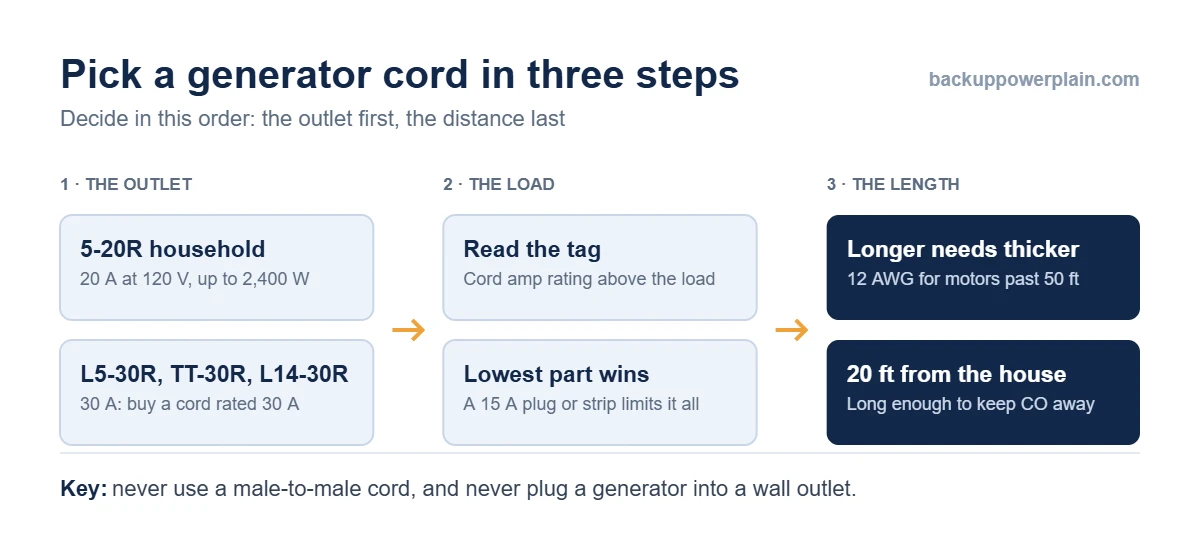
The fix is simple once you know the order to decide things in. Start with the outlet on your generator, then the load, then the distance. This guide walks through each one, with a cord finder that does the matching for you.
Step 1: Look at the outlet on your generator
Most portable generators have a few different receptacles, and each one sets a hard limit on what a single cord can carry. The maximum below is simply the outlet’s volts multiplied by its amps. Your generator’s running watts may be lower, and that is the real ceiling.
| Outlet on the generator | What it looks like | Rating | Most a cord on it can carry | Typical use |
|---|---|---|---|---|
| 5-20R (household duplex) | Normal three-prong outlet, often with a T-shaped slot | 20 A, 120 V | 2,400 W | Ordinary extension cords to a fridge, lamps, chargers, a CPAP |
| L5-30R (twist-lock) | Round, three curved slots, plug turns to lock | 30 A, 120 V | 3,600 W | Heavy 120 V cords and adapters |
| TT-30R (RV outlet) | Three straight slots, two angled | 30 A, 120 V | 3,600 W | Travel trailers and RVs |
| L14-30R (twist-lock, 4 slots) | Round, four curved slots | 30 A, 120/240 V | 7,200 W | A power inlet box feeding a transfer switch or interlock |
Two rules follow from this. First, a cord can never safely deliver more than the outlet it is plugged into. Second, a cord with 30 A twist-lock ends is built as a 30 A cord. Buy it rated for the full 30 A, not for what you plan to plug in today.
Find the right cord for your setup
Pick the outlet you will use, roughly how much you plan to run through this one cord, and how far it has to reach. The finder tells you which ends the cord needs, the minimum wire size and how much voltage you would lose along the way.
Generator cord finder
A starting point based on the outlet, the load and the length. Always follow the amp rating printed on the cord’s tag and your generator’s manual.
What to look for
How the finder works: it picks the thinnest common wire size whose usual cord rating covers the load (16 AWG about 13 A, 14 AWG about 15 A, 12 AWG about 20 A, 10 AWG about 30 A) and keeps the estimated voltage drop at or under 5%. It never suggests less than 12 AWG for runs of 50 feet or more, or less than 14 AWG for anything above about 600 watts. The voltage drop uses standard resistance values for copper wire and counts the current going out and back. It is an estimate for planning, not a substitute for the cord’s label.
Why a thin or long cord causes trouble
Two separate things go wrong when a cord is too thin for the job.
Heat. Every cord has an amp rating printed on its tag or jacket. Run more current than that through it and the wire heats up, the insulation softens and the plug can melt. That is why the U.S. Consumer Product Safety Commission tells generator owners to make sure each cord’s wattage rating exceeds the total wattage of everything connected to it.
Voltage drop. Even within its rating, a long, thin cord wastes some voltage as heat along the way. A 120-volt generator might deliver noticeably less at the far end of a 100-foot cord. Lights barely care, but motors do: a fridge compressor or a sump pump starting on low voltage draws more current and runs hotter. The table below shows how quickly the loss adds up for a 13-amp load (about 1,560 watts at 120 volts).
| Wire size | 25 ft | 50 ft | 100 ft |
|---|---|---|---|
| 16 AWG | 2.6 V (2.2%) | 5.2 V (4.4%) | 10.4 V (8.7%) |
| 14 AWG | 1.6 V (1.4%) | 3.3 V (2.7%) | 6.6 V (5.5%) |
| 12 AWG | 1.0 V (0.9%) | 2.1 V (1.7%) | 4.1 V (3.4%) |
| 10 AWG | 0.6 V (0.5%) | 1.3 V (1.1%) | 2.6 V (2.2%) |
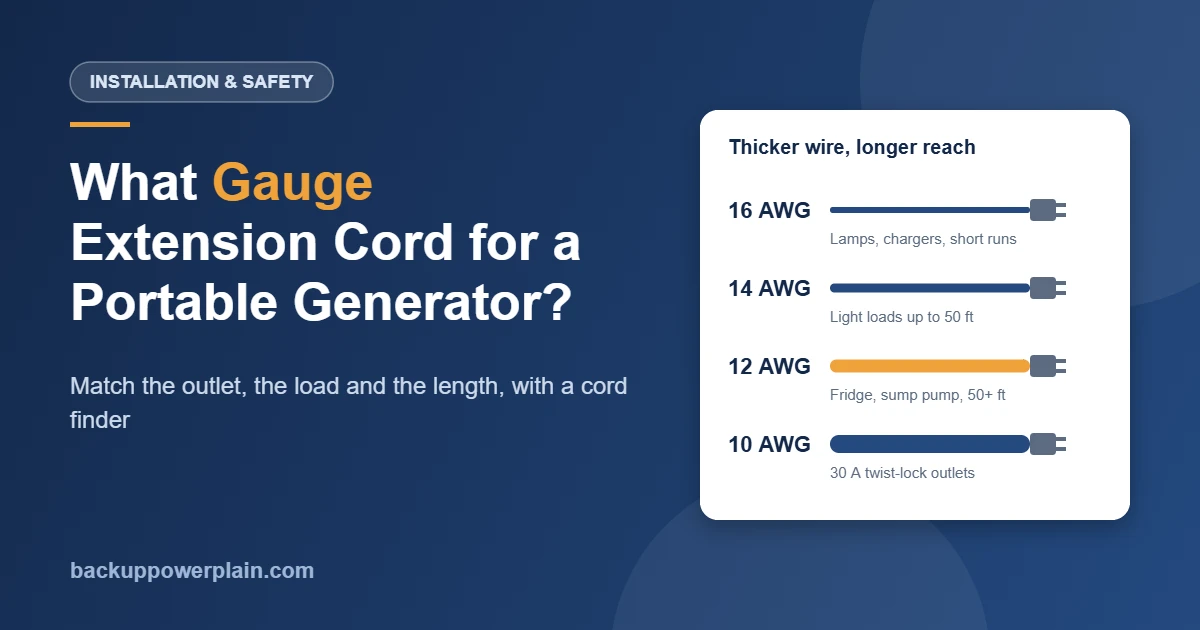
The pattern is what matters: halving the length halves the loss, and each step down in AWG number (thicker wire) cuts it by roughly a third. A 16-gauge cord is fine for a lamp across the yard. For anything with a motor, or for runs of 50 feet or more, a 12-gauge cord is the usual sensible minimum.
Some manufacturers are stricter than this. Generac’s owner’s manual for the XD5000E portable generator, for example, tells owners to limit extension cords to 15 feet or less to prevent voltage drop and overheating. On its 20-amp household outlets it calls for well-insulated, three-wire grounded cord sets rated 125 volts at 20 amps or more, and on its L14-30 outlet a four-wire grounded cord set rated 250 volts at 30 amps or more. If your manual gives a limit, it wins.
How to read the label on a cord
Outdoor cords carry a code on the jacket, such as SJTW 12/3 125V 15A. The numbers are the useful part: 12/3 means 12-gauge wire with three conductors (hot, neutral and ground), and 15A is the most current the cord set is rated for, usually limited by its plug. The letters describe the jacket. The W means it is rated for outdoor and wet locations, which is what you want next to a generator; O means oil-resistant and J means a lighter “junior” service cord. If the tag says 15A, treat 15 amps as the limit even if the wire inside could take more.
The safety rules that come with any cord
The CPSC’s portable generator safety alert lists the cord rules in a few lines. Use heavy-duty extension cords designed for outdoor use. Check that the whole length is free of cuts or tears and that the plug has all three prongs. Keep cords from being pinched in doors or windows. And use cords long enough that the generator can sit outdoors and far away from windows, doors and vents: the CPSC’s carbon monoxide guidance says at least 20 feet from the house. Our guide to generator carbon monoxide safety explains why that distance matters more than anything about the cord.
There is one kind of cord to never own: a male-to-male cord, sometimes sold as a “suicide cord” or generator “pigtail”. In 2026 the CPSC issued several warnings telling consumers to stop using these cords immediately. Their exposed prongs become live when the other end is plugged into a generator, and they are used to backfeed a house through a wall outlet, which can kill a utility worker on the line. Our article on why backfeeding is dangerous covers this in detail.
When an extension cord is the wrong tool
Cords work well for a handful of appliances: the fridge, a freezer, some lights, a CPAP, a few chargers. They stop making sense when you want to run hardwired circuits such as a furnace blower, a well pump or a ceiling light, or when you find yourself snaking four cords through a cracked-open window.
That is the point to look at a power inlet box with a transfer switch or an interlock kit, fed by a single L14-30 cord from the generator. A licensed electrician installs the inlet and the switch, and then one cord does the job of many, safely. If you are still working out how much the generator itself needs to supply, start with our generator sizing guide.
Quick answers
Can I join two extension cords together?
It is better not to. Every connection is another place for heat and water to cause trouble, and the voltage drop is the same as one cord of the combined length. If you must, both cords need to be outdoor-rated and at least as heavy as a single cord of that total length would need to be, and the joint should stay off wet ground.
Is a power strip on the end of the cord okay?
Only if the total load stays within the lowest rating in the chain, which is often the power strip at 15 amps. A strip does not add capacity; it only adds outlets.
What cord should I use for a refrigerator?
A typical household fridge runs on a few hundred watts but needs extra current for a moment when the compressor starts. A 12-gauge outdoor cord of 50 feet or less, plugged into a 20-amp outlet, covers most fridges comfortably. Check the fridge’s nameplate for its rated amps.
Before the next outage
Take the cords out of the garage now, not during the storm. Unroll each one, check the jacket and the three prongs, read the amp rating on the tag and write the length on a piece of tape near the plug. Make sure at least one cord matches each outlet type on your generator, and that the longest one reaches from a spot 20 feet from the house to where you need power. That ten-minute check is what keeps the night of the outage boring.
Sources
- U.S. Consumer Product Safety Commission, safety alert: portable generator hazards
- CPSC warning on male-to-male extension cords (2026)
- CPSC, extension cord recalls
- Generac, XD5000E portable generator owner’s manual (extension cord guidance)
Voltage drop figures are our own calculation from standard copper wire resistance and are labeled as such. General information only: follow your generator’s manual and the rating printed on each cord, and have a licensed electrician install any inlet, interlock or transfer switch.

About BackupPowerPlain
BackupPowerPlain is a team specialized in home backup power. We turn generator manuals, spec sheets and official safety guidance into plain guides with the math shown. We don't sell or install generators and have no brand to push.