Last verified: October 1, 2026
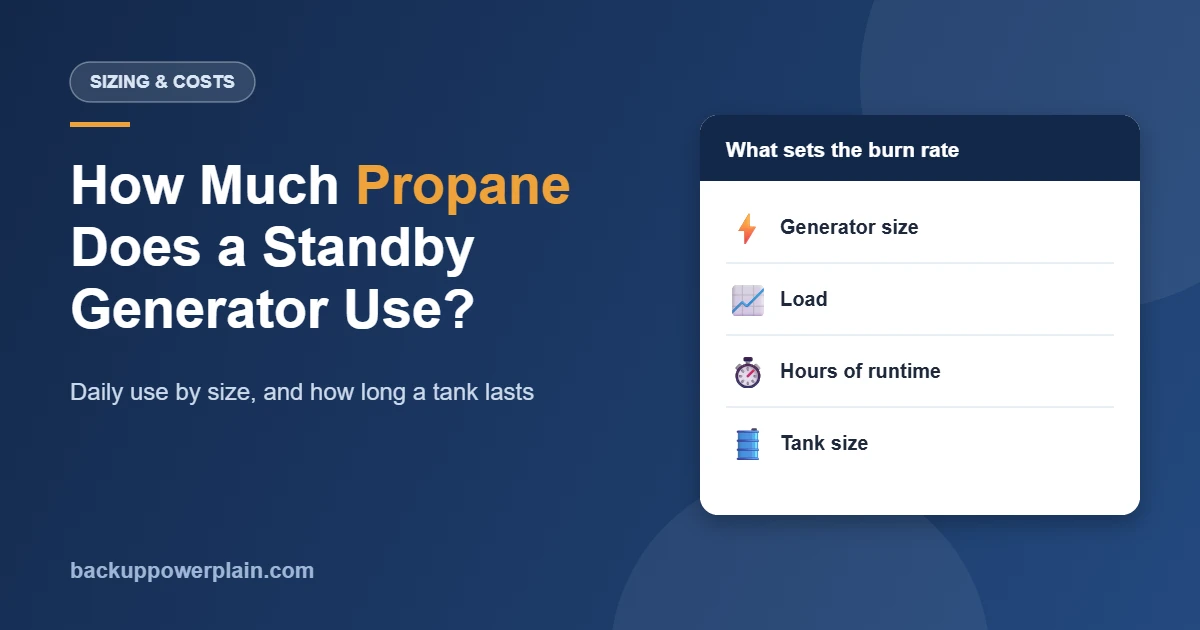
A typical 22 kW standby generator burns about 2.5 gallons of propane per hour at half load, or roughly 60 gallons a day. A smaller 10 kW unit uses about 1 gallon an hour (around 23 gallons a day). That means a 500-gallon tank, filled to the usual 80%, runs a 22 kW unit for about 6–7 days at half load.
Propane use by generator size
| Generator | Per hour, ½ load | Per day, ½ load | Per hour, full load | Per day, full load | Cost per day, ½ load |
|---|---|---|---|---|---|
| 10 kW | 0.97 gal | 23 gal | 1.48 gal | 36 gal | About $62 |
| 14 kW | 1.81 gal | 43 gal | 3.07 gal | 74 gal | About $116 |
| 18 kW | 1.7 gal | 41 gal | 3.02 gal | 72 gal | About $109 |
| 22 kW | 2.53 gal | 61 gal | 3.9 gal | 94 gal | About $162 |
| 24 kW | 2.53 gal | 61 gal | 3.9 gal | 94 gal | About $162 |
Consumption: Generac Guardian air-cooled range, from the manufacturer’s Guardian Series brochure. Cost at $2.67 per gallon, the U.S. average residential propane price in March 2026 (EIA). Other brands are in a similar range; always check the spec sheet of your exact model.
What “half load” means in real life
A generator’s fuel use depends on how much power your home is drawing, not on the size printed on the label. In an outage, most homes run well below full load most of the time: the fridge, furnace and pumps cycle on and off, lights and electronics draw little. Half load is a reasonable planning figure; with central air running in a heat wave, plan closer to full load.
How many days will your tank last?
Propane tanks are filled to about 80% of their water capacity to leave room for expansion. Days of runtime at half load, running around the clock:
| Generator | 250-gal tank (200 usable) | 500-gal tank (400 usable) | 1,000-gal tank (800 usable) |
|---|---|---|---|
| 10 kW | 8.6 days | 17.2 days | 34.4 days |
| 14 kW | 4.6 days | 9.2 days | 18.4 days |
| 18 kW | 4.9 days | 9.8 days | 19.6 days |
| 22 kW | 3.3 days | 6.6 days | 13.2 days |
| 24 kW | 3.3 days | 6.6 days | 13.2 days |
If propane also heats your home or water, those appliances draw from the same tank. In winter, a furnace can use as much propane as the generator, so plan for a bigger tank or more frequent deliveries.
Turning your tank gauge into hours
Most propane tanks have a gauge under the lid that shows the fill level as a percentage of the tank’s total capacity, not of the usable 80%. That makes the conversion simple: usable gallons are the tank size multiplied by the gauge reading. Divide by your generator’s consumption to get hours.
On a 500-gallon tank, a gauge reading of 80% (just filled) means 400 gallons: about 158 hours (6.6 days) for a 22 kW unit at half load, or about 221 hours (9.2 days) for a 14 kW unit. At 60%, 300 gallons give about 119 hours (4.9 days) and 166 hours (6.9 days). At 40%, 200 gallons give about 79 hours (3.3 days) and 110 hours (4.6 days). At 20%, the 100 gallons left last only about 40 hours (1.6 days) on the 22 kW and 55 hours (2.3 days) on the 14 kW.
Gauges are approximate, and a tank that also feeds a furnace or water heater will empty faster. Most propane companies advise ordering well before the gauge falls to about 20–30%; check your supplier’s own guidance, because running a tank completely empty usually means a leak check before it can be refilled.
A more realistic outage day
Real outages are rarely a steady half load. Here is a simple way to estimate a hot summer day for a 22 kW unit with central air: assume the eight hottest hours are close to full load and the other sixteen are around half load.
- Afternoon, AC running hard: 8 hours near full load at 3.90 gallons an hour, about 31 gallons.
- Night and morning: 16 hours near half load at 2.53 gallons an hour, about 40 gallons.
That’s about 72 gallons for the day, roughly $191.
That is about 18% more than the half-load planning figure of 61 gallons a day. On a full 500-gallon tank, it shortens the runtime from about 6.6 days to about 5.6 days. A few degrees higher on the thermostat during the afternoon, or a load-management switch that keeps the AC from running alongside other big loads, can win much of that back. Adjust the split of hours to match how your household actually lives during an outage; in a mild season with no AC, the half-load figure, or even lower, is closer to the truth.
How to stretch your propane in a long outage
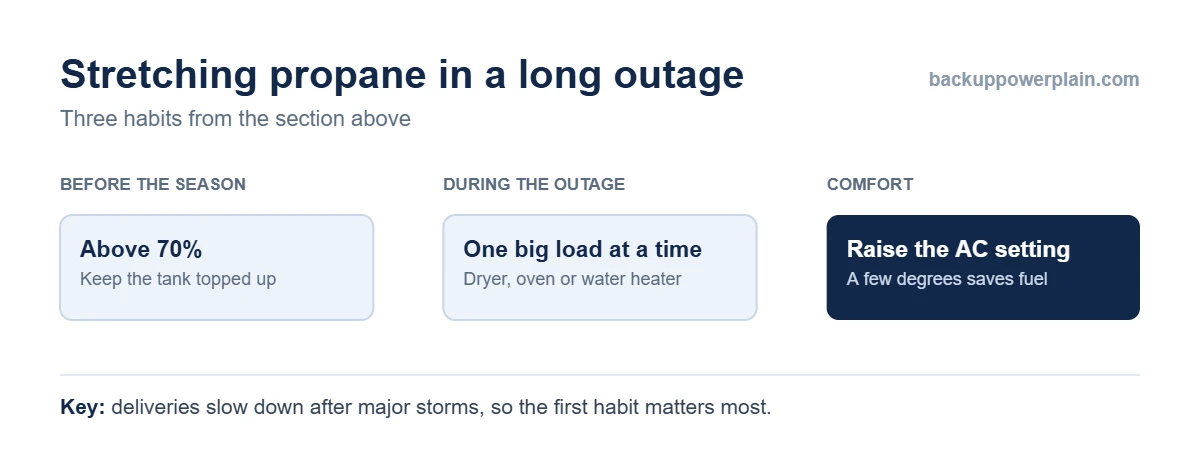
- Keep the tank above 70% before storm season. Deliveries slow down after major storms.
- Avoid big loads at the same time. Run the dryer, oven or water heater one at a time, or not at all.
- Raise the AC thermostat a few degrees. The compressor is usually the biggest continuous load.
- Use load management. Many transfer switches can shed large appliances automatically.
- Know your weekly exercise use. The automatic self-test burns a little fuel every week; it adds up over a year but is small next to an outage.
Propane or natural gas?
If you have a natural gas line, it usually costs about half as much per hour and never runs out. Compare both in Natural Gas vs Propane Generator.
Worked example: planning propane for a 5-day hurricane outage
A family in coastal South Carolina has a 22 kW standby generator on propane and a 500-gallon tank. They expect the generator to run around the clock for five days after a hurricane, at about half load with the AC running part of the time.
- Five days of round-the-clock running is 120 hours.
- At half load, 120 hours × 2.53 gallons per hour needs about 304 gallons.
- A full 500-gallon tank, filled to 80%, holds 400 usable gallons, so there’s enough with about 96 gallons to spare.
- If the tank is only half full (200 usable gallons), it lasts 200 ÷ 2.53, about 79 hours or 3.3 days.
- The fuel for the full five days costs about 304 × $2.67, roughly $811.
The lesson: the tank size is fine, but only if it’s topped up before the season. Starting the storm at half a tank cuts the runtime to just over three days.
Shared tanks: heating, cooking and the generator
If your home heats water, cooks or heats with propane, those appliances draw from the same tank. In summer, a water heater and stove add relatively little. In a winter ice storm, a propane furnace can burn as much as the generator, roughly halving your runtime. Ask your propane supplier to help you estimate combined winter use, and consider a larger tank or a second tank if you rely on propane for both heat and backup power.
Leasing vs owning the tank
- Leased tank: lower upfront cost, but you usually have to buy fuel from the company that owns the tank.
- Owned tank: higher upfront cost, but you can shop around for propane prices and delivery terms.
Either way, ask about “will call” versus automatic delivery. Automatic delivery keeps the tank topped up during storm season without you having to remember.
Frequently asked questions
Why is my generator using more propane than the table says?
The table uses half load. Heavy use of central air, electric cooking or a large well pump pushes the generator toward full load, where Generac’s 22 kW unit uses 3.90 gallons an hour, about 94 gallons a day. Cold weather, if the same tank feeds a furnace, adds more.
Can I run a standby generator on 100 lb cylinders?
Not for a whole-house unit in a long outage: a 100 lb cylinder holds about 23.6 gallons and lasts only a few hours on a large generator. Standby units are normally connected to a permanent tank sized for days of running.
Related guides
- How Much Natural Gas Does a Home Generator Burn?
- Hidden Generator Installation Costs: Gas, Electrical, Pad and Permits
- Generator Size for a Well Pump, Sump Pump and Fridge
- What Size Generator to Run Central Air Conditioning?
Sources
- Generac, Guardian Series home standby generators brochure
- U.S. Energy Information Administration, residential propane prices
About BackupPowerPlain
BackupPowerPlain is a team specialized in home backup power. We turn generator manuals, spec sheets and official safety guidance into plain guides with the math shown. We don't sell or install generators and have no brand to push.