Last verified: October 28, 2026 · Reviewed by Javier Braojos, electrical engineer
A summer outage is uncomfortable. A winter outage can be dangerous: no heat, frozen pipes, and the temptation to run a generator somewhere it should never run. The good news is that most winter generator failures are preventable with a few checks done before the first ice storm. This guide covers what to do for a standby generator and for a portable one, what to check when a storm is forecast and how to stay safe while it runs.
The short answer
- Do your checks in the fall, not during the storm. Oil, battery, fuel and a test run are easy in October and hard in a blizzard.
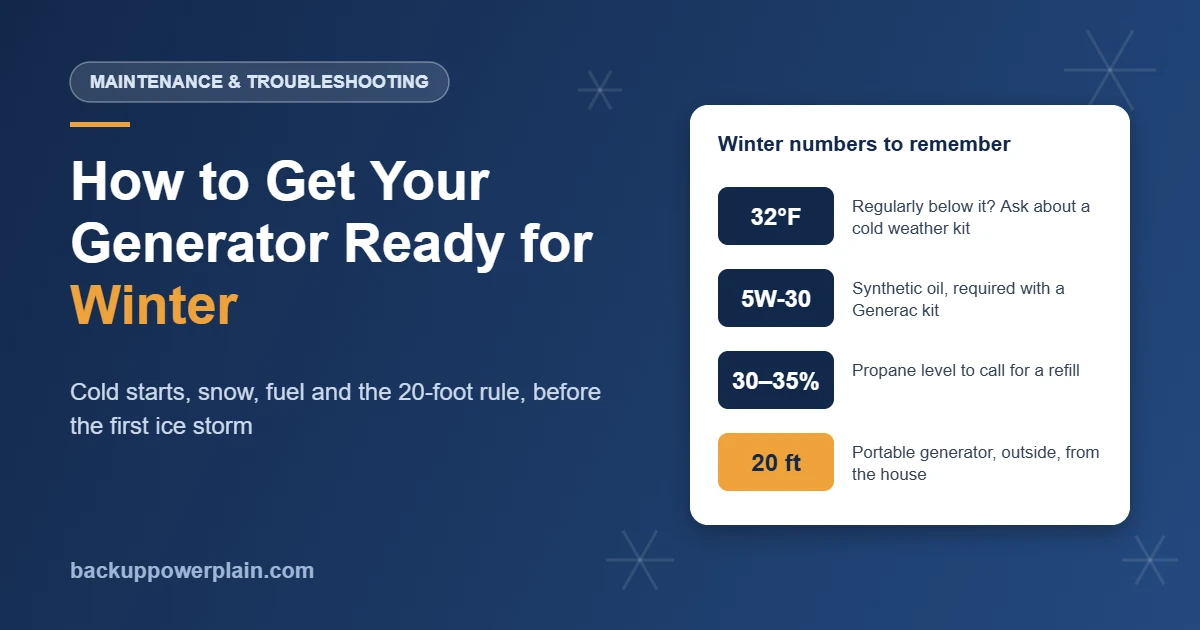
- If winters regularly drop below freezing, ask about a cold weather kit. Generac recommends its kits where temperatures regularly fall below 32°F, and calls for full synthetic oil (5W-20 or 5W-30, depending on the generator) when one is installed.
- Keep snow away from the generator and the fuel. Clear the enclosure, the exhaust and the propane tank with a broom, not a shovel or a kick.
- A portable generator always runs outside, at least 20 feet from the house. Never in the garage, not even with the door open, and never on a porch or in a carport.
Why winter outages are different
Winter storms knock out power for long stretches, and the cold turns an inconvenience into a health risk. During the February 2021 freeze, more than 4.5 million people in Texas lost power, some for as long as four days, while temperatures stayed below freezing for over six days. According to the joint FERC and NERC report on the event, at least 210 people died, most of the deaths connected to the outages, from causes that included hypothermia and carbon monoxide poisoning.
Carbon monoxide is the risk that grows in winter, because people want the generator close and out of the snow. The U.S. Consumer Product Safety Commission (CPSC) says an average of nearly 100 people die in the U.S. each year from carbon monoxide poisoning caused by portable generators. If you only remember one thing from this guide, make it the 20-foot rule. Our generator carbon monoxide safety guide covers it in detail.
Standby generator: the winter checklist
1. Decide whether you need a cold weather kit
Cold makes engines harder to start: the oil thickens and the starting battery delivers less power. Manufacturers sell cold weather kits to help. Generac’s help center lists battery pad warmers among its cold weather accessories and says their thermostats typically switch on at 40°F and off at 55°F. Generac recommends the kits for generators installed where the temperature regularly falls below 32°F. Other manufacturers sell their own cold weather accessories.
Kits are model-specific, and the heaters run on 120 V power. Ask your dealer which kit fits your unit, and have it installed before the first freeze.
2. Use the right oil for the cold
Thick oil is the main reason a cold engine cranks slowly. Generac calls for full synthetic oil (5W-20 or 5W-30, depending on the generator) when one of its cold weather accessories is installed. Without a kit, use the grade your owner’s manual lists for your winter temperatures. Many schedules also shorten the oil change interval for cold-climate duty, so check when your last change was. Our generator oil change guide explains the intervals and grades.
3. Check the starting battery
The battery has to crank a cold engine at the worst moment. Before winter, check that the terminals are clean and tight and that the controller shows no battery warnings. If the battery is several years old, ask your dealer to load-test it during the fall service. A weak battery that passes the weekly exercise in October can fail on the first frozen morning.
4. Keep the enclosure clear of snow and ice
A standby generator needs air in and exhaust out. After every snowfall, clear the snow from around the enclosure, the air intake louvers and the exhaust side, and knock ice off the lid gently so you can open it. Do not cover the unit with a tarp or build a box around it: the enclosure is designed to stay outside, and blocking the airflow can make it overheat or push exhaust where it shouldn’t go.
5. Let the weekly exercise keep running
The automatic exercise run is your early warning. If the generator fails a test in December, you want to know before the ice storm, not during it. Check the controller after each run and keep the exercise schedule on through the winter. See generator exercise settings for how often it should run.
6. Check the fuel supply
Propane: watch the tank gauge. Ferrellgas, a national propane supplier, advises calling for a refill when the tank reaches 30 to 35 percent, because deliveries can be delayed when roads are icy. Clear snow and ice from around the tank with a broom to avoid damaging the regulator and fittings, mark buried tanks so the driver can find them, and never use a heat source to warm the tank. Remember that a propane furnace and a generator draw from the same tank. In a long freeze the furnace can burn as much as the generator, which is why our propane use guide recommends planning for both.
Natural gas: there is no tank to fill, but keep the gas meter and the generator’s gas line clear of snow and ice so the utility can read and reach the meter.
Portable generator: the winter checklist
- Test it before the storm. Start it outdoors, let it run under a small load for a few minutes and shut it down as the manual says. A generator that has sat since summer is the one that won’t start when you need it.
- Plan where it will run. The CPSC says to run portable generators outside only, at least 20 feet from the house, with the exhaust pointed away from doors, windows and vents. A porch or carport is too close. Pick the spot now and keep a path to it shoveled.
- Protect it from snow the safe way. Follow the manufacturer’s instructions for bad weather. The CPSC notes that these may include using an NFPA-rated noncombustible generator tent, or may tell you to wait until the rain or snow passes. A tarp tied over a running generator is not one of the options.
- Store fuel safely and have enough. Keep gasoline in approved containers, away from the house and the generator. Let the generator cool before refueling: Ready.gov warns that fuel spilled on hot engine parts can ignite. To estimate how much fuel you need, see how long a generator can run continuously.
- Use the right cords. Ready.gov advises heavy-duty extension cords. Our extension cord gauge guide shows which size you need for the load and the distance.
- Never backfeed. Plugging a generator into a wall or dryer outlet can electrocute utility workers repairing lines in the storm. Use a transfer switch or an interlock kit; see generator backfeeding dangers.
When to do what
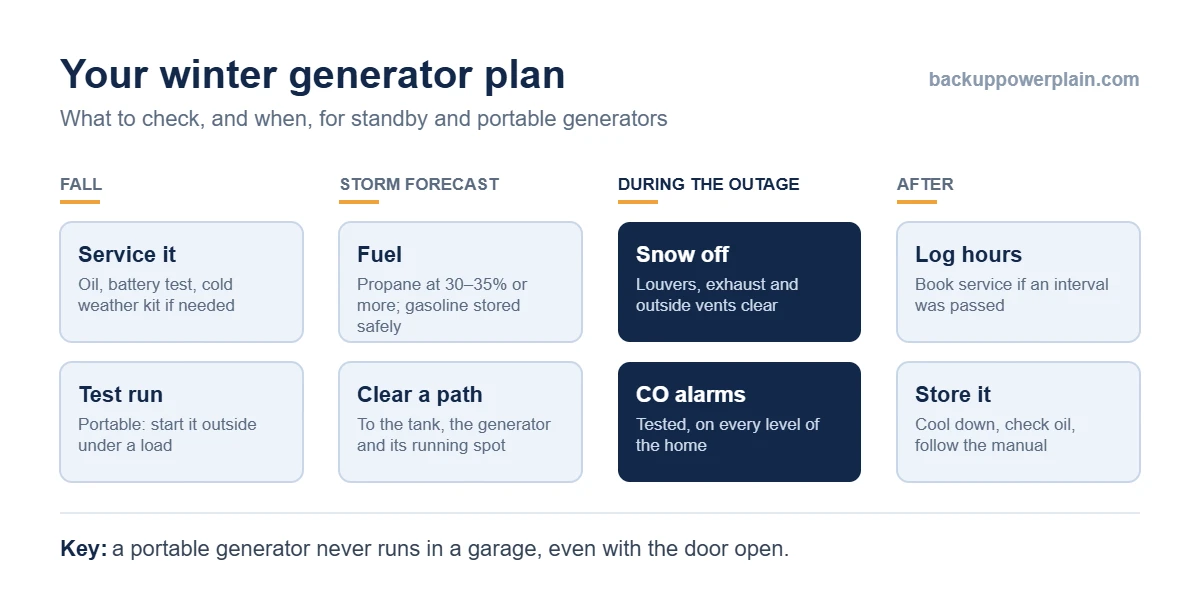
| When | Standby generator | Portable generator |
|---|---|---|
| Before winter (fall) | Dealer service, oil change if due, battery test, cold weather kit if you need one | Oil change if due, test run under load, buy fuel, cords and CO alarms |
| When a storm is forecast | Check the controller for warnings, propane at 30–35% or more, snow cleared | Fuel stored safely, running spot chosen 20+ feet away, path shoveled |
| During the outage | Check oil daily on long runs, clear snow from louvers and exhaust | Refuel only when cool, keep exhaust away from the house, check CO alarms |
| After the storm | Log the run hours, schedule service if an interval was passed | Let it cool, check the oil, store fuel and the generator as the manual says |
Inside the house during a winter outage
- Test your carbon monoxide alarms. Ready.gov recommends CO detectors with battery backup on every level of the home.
- Never heat the house with a gas stove or oven. Ready.gov warns that it raises the risk of carbon monoxide poisoning.
- Clear outside vents. Furnace and dryer vents blocked by snow can push exhaust back inside.
- Keep the fridge and freezer closed. A full freezer holds its temperature for about 48 hours; the refrigerator about four. Our food safety guide explains what to keep and what to throw out.
- Plan for medical devices. If someone uses a CPAP or other powered device, see how to power a CPAP during an outage.
Frequently asked questions
Can I run a portable generator in the garage with the door open?
No. The CPSC says never to run a portable generator inside a home, garage, basement, crawlspace, shed or other enclosed space, and that open doors or windows don’t provide enough ventilation. Run it outside, at least 20 feet from the house.
Can propane freeze in my tank?
Not in a U.S. winter. Ferrellgas notes that liquid propane would have to reach about -306°F to freeze. What does happen in deep cold is that the tank pressure drops, because propane boils at about -44°F. That is one more reason to keep the tank well above empty during a cold snap.
Do I need a cold weather kit if I live in the South?
Usually not. Generac recommends its kits where temperatures regularly fall below 32°F, which describes northern winters better than an occasional Southern freeze. If you live where a hard freeze is rare, a healthy battery, the correct oil and a passing exercise run are what matter most. Your dealer can tell you whether a kit is worth it for your climate and model.
Should I cover my standby generator for the winter?
No. The enclosure is the weather protection. Covering it can block the air intake and exhaust, and the generator has to be ready to start automatically at any moment. Keep it clear of snow instead.
Keep reading
- Using a portable generator in rain or snow
- Standby generator maintenance checklist
- Can a generator run your furnace or heat pump?
- How to prepare your generator before hurricane season
- Generator carbon monoxide safety
Sources
- FERC, NERC and Regional Entity staff, The February 2021 Cold Weather Outages in Texas and the South Central United States (November 2021)
- U.S. Consumer Product Safety Commission, winter storm carbon monoxide and fire warning (February 19, 2026)
- Generac Help Center, cold weather accessories for home standby generators (September 2026)
- Ready.gov, Winter weather
- Ready.gov, Power outages
- Ferrellgas, 5 propane-related winter weather tips
- Ferrellgas, How to care for a propane tank in cold weather
About BackupPowerPlain
BackupPowerPlain is a team specialized in home backup power. We turn generator manuals, spec sheets and official safety guidance into plain guides with the math shown. We don't sell or install generators and have no brand to push.