Last verified: November 8, 2026 · Reviewed by Javier Braojos, electrical engineer
When the power goes out in January, heat is the first thing you want back. The answer to whether a generator can run it depends almost entirely on what kind of heating you have. A gas furnace needs surprisingly little electricity, because the gas makes the heat and the electricity only runs the fan and controls. A heat pump makes its heat with electricity, so it needs many times more. This guide shows the numbers for each, with two worked examples, and how to connect your heating safely.
The short answer
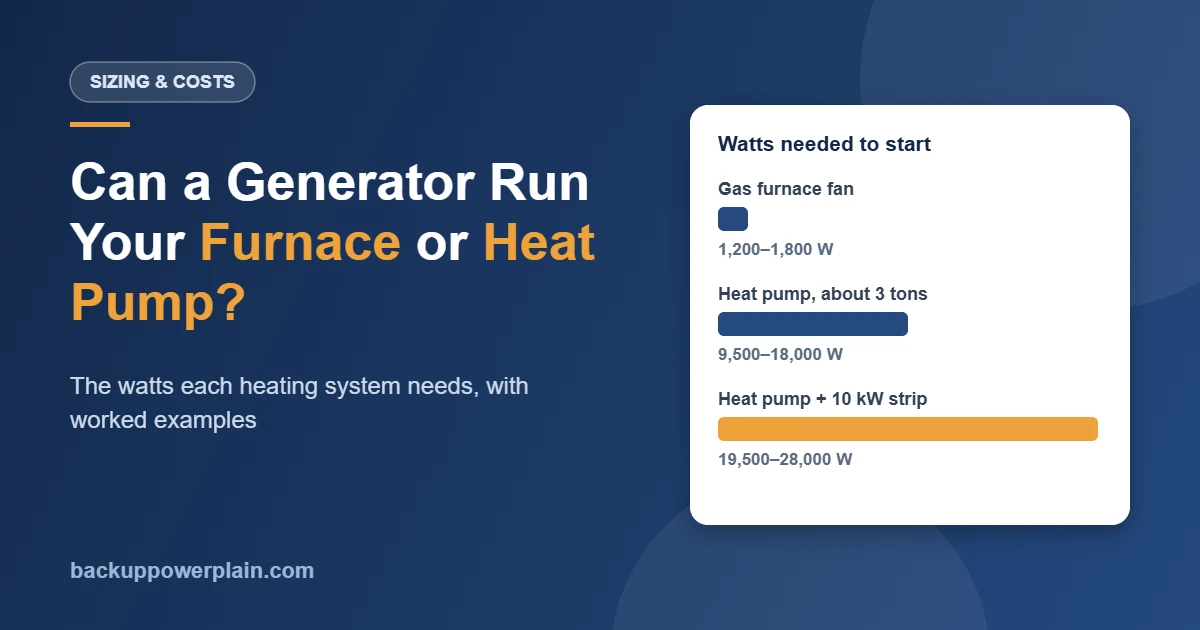
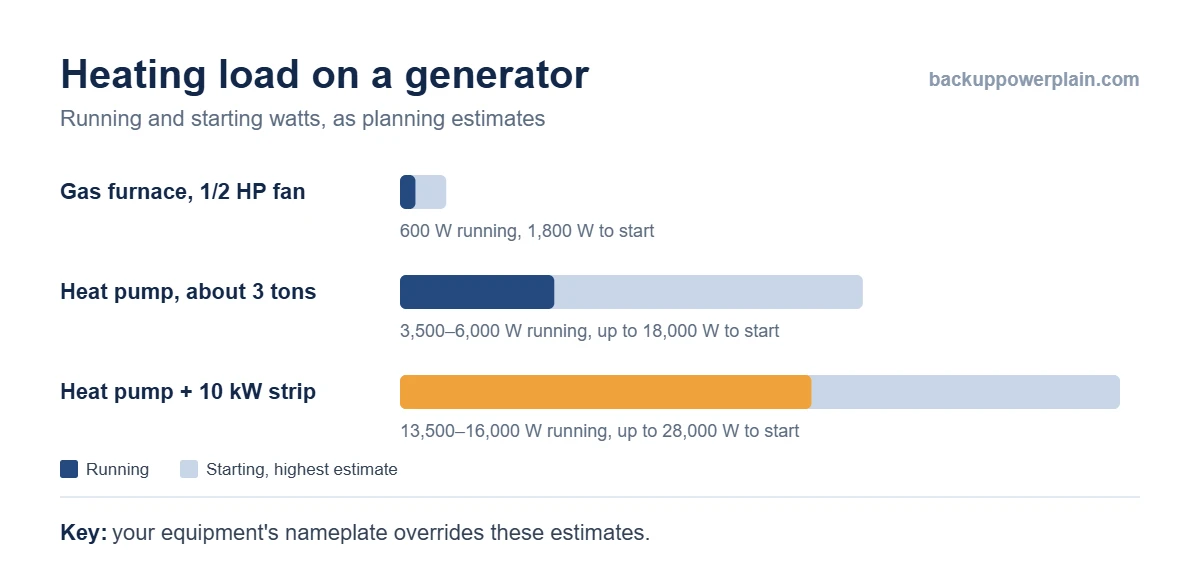
- Gas or propane furnace: usually yes, even with a portable generator. The blower fan uses about 400 to 600 watts running and about 1,200 to 1,800 watts to start, by the estimates in DTE Energy’s appliance guide.
- Heat pump: only with a large generator. A central unit of about 3 tons typically needs 3,500 to 6,000 watts running and 9,500 to 18,000 watts to start, depending on the estimate. Most portable generators cannot start one.
- Electric backup heat strips are the real problem. A 10 kW strip draws about 42 amps at 240 volts on its own, on top of the fan.
- A furnace or heat pump is hardwired, so it needs a proper connection. That means a transfer switch or interlock kit installed by an electrician, never a cord plugged into a wall outlet.
How much power each system needs
| Heating system | Running watts | Starting watts | Generator that usually fits |
|---|---|---|---|
| Gas or propane furnace, 1/4 HP fan | 400 | 1,200 | Portable, once other loads are added |
| Gas or propane furnace, 1/3 HP fan | 450 | 1,350 | Portable, once other loads are added |
| Gas or propane furnace, 1/2 HP fan | 600 | 1,800 | Portable, once other loads are added |
| Central heat pump of about 3 tons, no heat strips | 3,500 to 6,000 | 9,500 to 18,000 | Standby generator, 14 kW or more |
| 10 kW electric heat strip | 10,000, plus the fan | No motor start; the load comes on all at once | Adds about 10 kW to whatever else you run |
These are planning numbers, not a substitute for your own. The model and ratings are on a label inside the furnace panel and on the outdoor unit of a heat pump. Ask your HVAC technician or electrician to read them, and to measure the real starting draw if you are close to your generator’s limit.
Gas or propane furnace: the easy case
A gas furnace burns fuel for its heat. It only needs electricity for the blower fan, the igniter, the inducer fan and the control board. Because the fan is a motor, it pulls several times its running wattage for a moment when it starts, and that starting load is what you size for.
Worked example: furnace, fridge and lights
Take a furnace with a 1/2 HP fan (600 W running, 1,800 W starting), a refrigerator (750 W running, 2,250 W starting by the same guide) and 300 W of lights.
- Running load: 600 + 750 + 300 = 1,650 W.
- Worst case, if both motors start at the same moment: 1,800 + 2,250 + 300 = 4,350 W.
A generator rated around 5,000 watts covers that with some margin. Add a sump pump, a well pump or a microwave and the number climbs, so run your own list through our generator size calculator.
Two things people forget
- Fuel. In a propane home, the furnace and a propane generator draw from the same tank, and in a long freeze the furnace can burn as much as the generator. Our propane use guide shows how to plan for both.
- Vents. Keep the furnace’s outside intake and exhaust clear of snow, and have working carbon monoxide alarms on every level of the home, as Ready.gov recommends.
Heat pump: the hard case
A heat pump moves heat with an electric compressor, so all of its heating depends on your generator. Its compressor behaves much like a central air conditioner’s. Our central air guide uses typical figures of 3,500 watts running and 9,500 watts starting for 3 tons. DTE Energy’s guide is more cautious: about 6,000 watts running with a starting factor of 3, or about 18,000 watts at the moment the compressor starts. The data plate on your outdoor unit gives the real number. DTE’s own instructions tell customers using its 40-amp portable generator connection not to turn on a heat pump, because the starting wattage is more than that connection can carry.
Cold makes it harder. According to the U.S. Department of Energy’s Better Buildings program, air-source heat pumps become less efficient as the outside air gets colder, and standard units are rated down to 17°F. Below the point where the heat pump can keep up, many systems switch on electric resistance heat strips or a gas furnace as backup.
Worked example: heat pump with a 10 kW strip
- Strip alone: 10,000 W ÷ 240 V = about 42 amps.
- Heat pump plus strip, running: 3,500 to 6,000 W + 10,000 W = 13,500 to 16,000 W, before anything else in the house.
- Compressor starting while the strip is on: 9,500 to 18,000 W + 10,000 W = 19,500 to 28,000 W, if nothing prevents it.
That is why homes with a heat pump either buy a large standby generator or manage the load. See 14 kW vs 22 kW vs 26 kW generators for what each size can realistically carry.
Ways to bring the number down
- Ask about a soft starter. It lowers the compressor’s starting surge. Whether one fits depends on your unit, so check with your HVAC technician and the manufacturer first.
- Use load management. A load manager can keep the strips or the water heater off while the compressor runs. Our load management guide explains how it works.
- Keep a separate heat source for outages. A dual-fuel system with a gas furnace needs far less generator power. Any fuel-burning heater must be rated for indoor use and installed and vented as the manufacturer says.
How to connect your heating safely
Furnaces and heat pumps are normally wired directly into a circuit breaker, so you cannot just run an extension cord to them.
- Use a transfer switch or an interlock kit, installed by a licensed electrician, usually with a permit. Our guides explain how a transfer switch works and compare an interlock kit with a transfer switch.
- Never backfeed. A generator plugged into a wall or dryer outlet can electrocute utility workers. See generator backfeeding dangers.
- Check that the power suits the furnace. Modern furnace control boards are electronic. Your furnace manual or manufacturer can tell you whether it has any requirements for generator power.
- Keep a portable generator outside, at least 20 feet from the house, as the CPSC says, with the exhaust pointed away from doors, windows and vents. A porch, carport or garage is too close.
Frequently asked questions
What size generator runs a gas furnace?
The fan alone needs about 1,200 to 1,800 watts to start, by DTE Energy’s estimates. In practice you will also want a refrigerator and lights, which brings a typical list to around 4,000 to 5,000 watts, as in the example above.
Can a 7,500-watt portable generator run a heat pump?
Usually not. Even the lower estimate for a 3-ton unit, about 9,500 watts to start, is more than a 7,500-watt generator can deliver. A small or variable-speed unit may need much less, so check your unit’s nameplate and ask an HVAC technician before you buy anything.
Can I plug my furnace into a generator with an extension cord?
Not if it is hardwired, which most are. Changing the wiring is a job for a licensed electrician or HVAC technician, who can install a transfer switch or a dedicated connection that follows your local code.
Keep reading
- How to get your generator ready for winter and ice storms
- What size generator do you need for central air?
- What size generator do I need?
Sources
- DTE Energy, Appliance Usage Guide and GenerLink worksheet
- U.S. Department of Energy, Better Buildings: Heat Pumps, From Basics to Advanced (2023)
- U.S. Consumer Product Safety Commission, winter storm carbon monoxide and fire warning (February 19, 2026)
- Ready.gov, Power outages
About BackupPowerPlain
BackupPowerPlain is a team specialized in home backup power. We turn generator manuals, spec sheets and official safety guidance into plain guides with the math shown. We don't sell or install generators and have no brand to push.