Last verified: October 1, 2026
A standby generator is only as good as its installation and the dealer who services it. These questions help you compare installers on the things that matter, spot weak quotes and avoid the most common surprises. Ask them on the site visit and get the key answers in writing.
Prepare for the site visit
You’ll get better, more comparable answers if every installer starts from the same information. Before the first visit, gather:
Start with your must-run list, with the appliances you could live without marked separately; our buying checklist has a summary table for this. Add photos of the AC data plate(s) showing RLA and LRA, of any well pump or sump pump label, and of your main electrical panel with the door open and the main breaker rating visible. A photo of your gas meter (or propane tank and its size) and a list of your other gas appliances tell the installer whether fuel supply could be a problem.
Then write down your outage history: how often, how long, and what went wrong last time. Finish with one or two places you’d like the unit to go, and any HOA rules that apply.
Share the same pack with every installer. If one of them recommends a very different size or setup from the others, you can ask why on the spot, using the same facts.
About the company
- Are you licensed and insured in my state, and can I see the license number? Electrical work must be done by a licensed electrician; gas work may need a separate license.
- Are you an authorized dealer for this brand? Many manufacturers require authorized installation or registration for full warranty coverage.
- How many of these units have you installed in the last year? Experience with the specific brand matters for setup and troubleshooting.
- Who will do the work: your employees or subcontractors?
- Can you give me two or three local references for installations at least a year old? You want to hear how service went after the installation, not only the installation itself.
About sizing
- How did you calculate the size you recommend? Ask to see the load calculation. A good answer mentions your largest motor loads, especially the AC.
- What output does this unit give on my fuel? Natural gas ratings are lower than propane ratings.
- Would a soft starter or load management let me use a smaller unit? Compare their answer with our central air sizing guide.
About the installation
- Where exactly will the generator go, and does that meet the manufacturer’s clearances and local code? Ask for a sketch.
- Have you checked my gas meter and pipe capacity? Is any upgrade included in the price, and who coordinates with the utility?
- What type and size of transfer switch is included, and does my panel need changes?
- Who pulls the permits and attends the inspection? Are fees included? See Do You Need a Permit?
- How long will it take from signing to a working generator? Including permits, utility work and equipment availability.
- What is not included in this quote? Pad, trenching, landscaping repair, tank, Wi-Fi setup, startup and registration are common gaps.
About service after installation
- What does annual maintenance cost, and what does it include? Get it in writing.
- What does the warranty cover: parts, labor, travel? For how long? And what do I need to do to keep it valid?
- After a hurricane or major storm, how do you prioritize service calls? Ask whether maintenance-plan customers come first.
- Do you monitor units remotely? Some dealers watch for alerts and contact you before a problem becomes a failure.
- Will you walk me through the controller, exercise schedule and manual shutdown when you’re done?
Compare quotes side by side
Before comparing totals, make sure every quote spells out the same items. If one quote leaves something out, ask the installer to add it in writing so you’re comparing like with like:
Start with the equipment: the generator model and its output on both fuels (natural gas and propane, in kW), plus the transfer switch type and amperage. Then look at the site work: the pad, the gas line length, a check of the gas meter’s capacity, and the electrical work, including any panel changes. Each quote should also say who handles permits and inspections and who attends them.
Finally, compare what happens after the sale: warranty terms for parts, labor and travel, and the annual maintenance price and what it includes. Only then look at the total price, with any items marked as possible extras.
How to read the answers
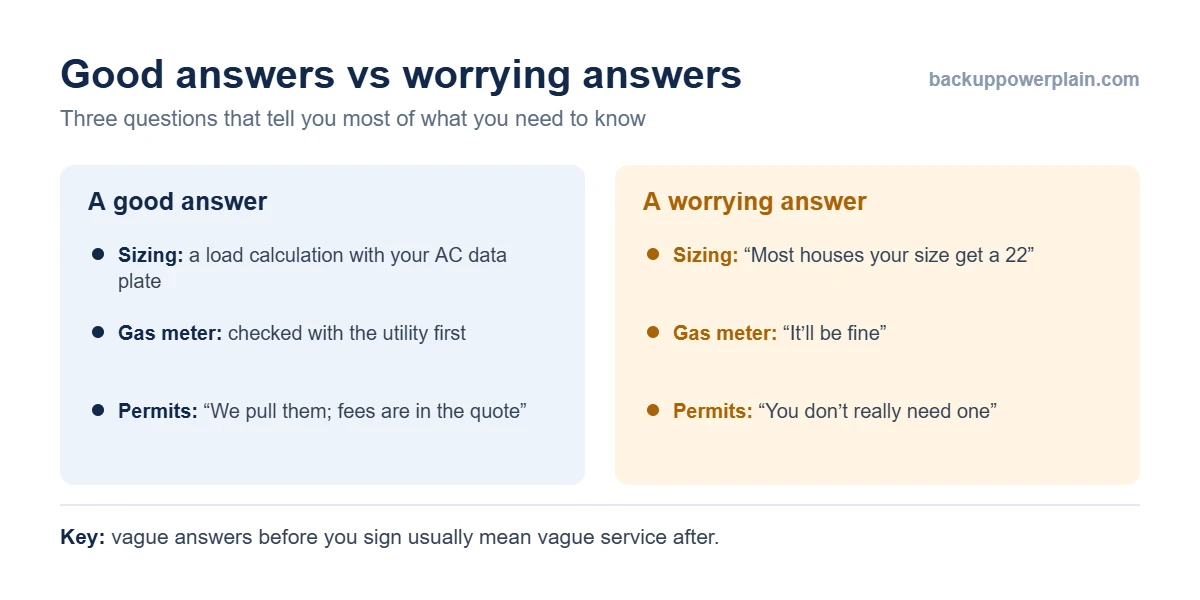
The way an installer answers tells you as much as the answer. Ask how they sized it, and a good reply sounds like “We listed your large loads, checked the AC data plate and did a load calculation.” A worrying one sounds like “Most houses your size get a 22.” On the gas meter, you want to hear “We’ll check capacity with the utility before we schedule,” not “It’ll be fine.” On permits, the right answer is “We do; fees are in the quote; we attend inspections,” and the wrong one is “You don’t really need one.”
Ask how fast they can come after a storm. A good dealer has a clear priority policy, especially for maintenance-plan customers, while no answer, or “it depends”, is a concern. And when you ask what’s not included, look for a specific list, such as trenching, landscaping and Wi-Fi setup, rather than “Everything’s included” with no detail.
A short example
A homeowner gets three quotes for a 22 kW unit. Quote A is the cheapest but lists only “generator and installation”. Quote B is in the middle and itemizes the 200 A switch, pad, 30 feet of gas line, permits and a meter check. Quote C is the most expensive but includes a two-year maintenance plan with priority storm service. Once the missing items in Quote A are added (gas line, permits, a possible meter upgrade), it’s no longer the cheapest. Quote B is the best value for a homeowner happy to maintain the unit themselves; Quote C makes sense for someone who wants guaranteed service after storms. The point is to compare like with like.
| Quote | What it lists | Verdict |
|---|---|---|
| A (cheapest) | Only “generator and installation” | No longer the cheapest once the gas line, permits and a possible meter upgrade are added |
| B (middle) | 200 A switch, pad, 30 ft of gas line, permits and a meter check | Best value for an owner happy to maintain the unit |
| C (most expensive) | All of B plus a two-year maintenance plan with priority storm service | Makes sense if you want guaranteed service after storms |
Questions for installation day
The last chance to catch problems cheaply is before the installer leaves. Ask them to walk you through these points, and don’t sign off until each one is done:
Begin outside with the placement. Ask “Can you show me the clearances from windows, doors and vents?” The unit should sit level on its pad, where the sketch showed it. Then ask for a real transfer test: “Can you simulate an outage so I can see it switch over and back?” Watch how long it takes and whether the AC and pumps restart normally.
Next, cover the settings and accounts. Ask what day and time the exercise is set for and pick a sensible slot, using Generator Exercise Settings as a guide. Ask whether the app is connected to your account and whether you’ll get alerts, and whether the warranty has been registered, with a confirmation sent to you. Have them show you where the gas shut-off valve and the generator’s main breaker are, and how to put the controller in Off or Manual.
Finally, ask whether the final inspection has passed or when it is scheduled, and don’t make the final payment until it has. Before they go, check the site: trench filled, landscaping repaired as agreed and packaging removed.
Ten minutes on these points saves a call-out later, and the handover is also the best moment to ask the questions every new owner has about noise, fuel use and what to do in the first real outage.
Paperwork to keep after installation
Keep the signed contract and final itemized invoice together with the permit numbers, inspection approvals and warranty registration or activation confirmation. Add the model and serial numbers of the generator and transfer switch, a photo of the controller’s settings (exercise day and time) and the installer’s emergency contact. You’ll want all of it the first time something needs a warranty claim.
Frequently asked questions
How many quotes should I get?
Three is a good number: enough to see the range of prices and approaches, not so many that comparing them becomes a chore. Give every installer the same information about your loads and fuel.
Should I choose the installer or the brand first?
For most homeowners, the installer. A good local dealer with strong service makes any mainstream brand work well; a weak one can make the best brand frustrating. Shortlist two or three well-reviewed dealers, then compare the brands they carry.
Is it normal to pay a deposit?
Many installers ask for a deposit to order the equipment. Be cautious about paying the full amount upfront, especially before permits are approved, and get the payment schedule in writing.
Warning signs
Be wary of a size recommended over the phone without a site visit, or a quote that isn’t written and itemized. “We don’t need a permit for this” is a red flag, and so is a large deposit demanded right after a storm, with pressure to sign today. Vague answers about who services the unit after installation should also make you keep looking.
For typical price ranges to compare against, see Whole House Generator Cost and Hidden Generator Installation Costs.
Related guides
- Standby Generator Placement: Clearances, Noise and Neighbors
- Generator Load Management Explained: Power More With a Smaller Unit
- How Long Does Generator Installation Take? From Quote to Power-On
- Why Backfeeding a Generator Is Dangerous (and Illegal)
Sources
- Generac, Guardian Series home standby generators brochure
- Generac Help Center, clearance requirements when installing a generator

About BackupPowerPlain
BackupPowerPlain is a team specialized in home backup power. We turn generator manuals, spec sheets and official safety guidance into plain guides with the math shown. We don't sell or install generators and have no brand to push.